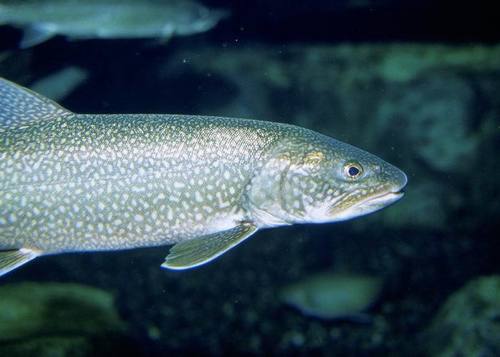
Lake Trout
Salvelinus namaycush
A deep-water titan of the north, the Lake Trout is a master of the cold. With its beautiful spotted coat and forked tail, this long-lived char is the ultimate symbol of pristine wilderness lakes.
Quick Identification
Size
60–90 cm (24–36 in) and 2–12 kg (5–25 lbs), though they can reach 120+ cm (48+ in) and over 40 kg (88 lbs).
Colors
Dark green to greyish-brown back with light cream or yellow spots; white belly; reddish-orange tint on lower fins with white leading edges.
Key Features
- Deeply forked tail fin
- Light spots on a dark background
- White leading edges on lower fins
- Large, toothy mouth
- Elongated, streamlined body shape
When You’ll See Them
Geographic range
Where Does the Lake Trout Live?
The Lake Trout is a native icon of northern North America, with a natural range that blankets nearly all of Canada from the Atlantic coast to the Yukon and Alaska. In the United States, they are a keystone species of the Great Lakes and are found natively throughout New England and the northern Rocky Mountains. Beyond their native waters, they have been successfully introduced to deep lakes in the western U.S., Europe, South America, and New Zealand, though they are most at home in the glacial-carved basins of the northern wilderness.
Basemap © OpenStreetMap contributors
Behavior
Lake Trout are the apex predators of cold, deep-water ecosystems, often referred to as the 'grey ghosts' of the north. Unlike many other trout, they are actually members of the char family, distinguished by their preference for highly oxygenated, oligotrophic lakes. They are remarkably slow-growing and long-lived, with some individuals reaching ages of 40 to 60 years in the cold waters of the Arctic.
These fish are highly sensitive to temperature and move vertically through the water column based on the seasons. In the summer, they retreat to the thermocline—the deep, cold layer of water—to stay at their preferred temperature of around 10°C (50°F). During the spring and autumn, when surface waters cool, they can be found cruising the shallows or rocky shoals. They are generally solitary hunters, though they may aggregate in large numbers over specific rocky reefs during their nighttime spawning runs in late October.
EverydayEarth exclusive
Camera Tips
To capture Lake Trout on camera, you must think vertically. Because these fish spend much of the year in deep water, an underwater drop-camera or a specialized submersible rig is essential. The best time to deploy your camera is during the spring or autumn 'turnover' when water temperatures are uniform. During these windows, Lake Trout move into shallower water (10-30 feet) to feed or spawn, where natural light is still sufficient for high-quality video without expensive artificial lighting.
Position your camera near structural transitions, such as where a rocky reef drops off into a deep basin or near underwater boulders. Lake Trout are highly curious and will often investigate new objects in their environment. To keep them in frame longer, use a scent lure: a mesh bag filled with cut oily fish like herring or sardines suspended three feet in front of the lens works wonders. The scent trail will draw them in from the depths, and you'll often see them make multiple 'drive-by' passes before approaching the bait.
For the best visual results, set your camera to record at 60 frames per second to capture their powerful, sweeping tail movements. If you are filming in deep water (40+ feet), use 'warm' LED lights to counteract the heavy blue tint of the water and bring out the subtle yellow and green spots on their skin. Avoid using motion triggers if there is a lot of floating debris or heavy current; instead, use time-lapse mode or continuous recording during peak morning and evening feeding hours.
Similar Species
Species that look similar or are commonly confused with Lake Trout.
Frequently Asked Questions
Record Lake Trout at your habitat
Connect a camera to start building your own species record — AI identifies every visitor automatically.