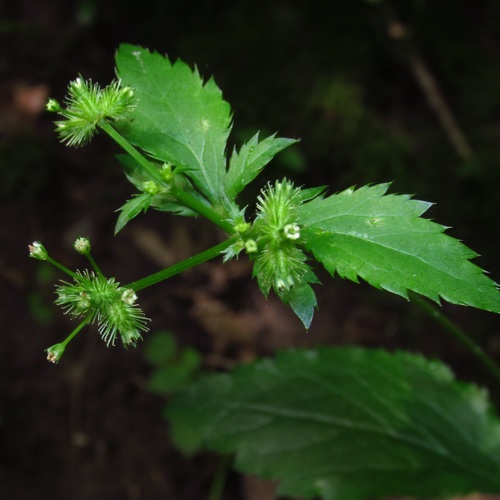
large-fruited sanicle
Sanicula trifoliata
The large-fruited sanicle is a master of the hitchhiking seed, thriving in the deep shadows of North America's ancient forests. With its distinctive trifoliate leaves and 'Velcro' fruits, it is a subtle but essential part of the woodland floor.
Quick Identification
Size
Height: 30–90 cm (12–35 inches); Fruit: 6–8 mm (0.2–0.3 inches) long
Colors
Bright green foliage, inconspicuous white flowers, and green to tan bristly fruits
Key Features
- Trifoliate (three-parted) leaves with serrated edges
- Fruit covered in hooked, Velcro-like bristles
- Central leaflet of basal leaves on a distinct stalk
- Flowers in small, rounded umbels
When You’ll See Them
Geographic range
Where Does the large-fruited sanicle Live?
Native to eastern North America, the large-fruited sanicle thrives across the temperate deciduous belt. Its core range extends from the southern reaches of Ontario and Quebec down through the Appalachian Mountains and into the American Midwest. You will most often encounter it in high-quality woodlands where the canopy provides consistent shade and the soil remains consistently moist throughout the growing season.
Basemap © OpenStreetMap contributors
Behavior
Large-fruited sanicle is a quiet inhabitant of the forest floor, emerging in the spring and blooming through the early summer. Unlike many showy wildflowers that rely on bright colors to attract pollinators, this species focuses its evolutionary energy on seed dispersal. Its fruits are covered in stiff, hooked prickles designed to catch on the fur of passing mammals or the clothing of hikers, a strategy known as epizoochory.
In the woodland ecosystem, it acts as a subtle understory resident, indicating a healthy, relatively undisturbed deciduous environment. It is a slow-growing perennial that is highly shade-tolerant, often growing in areas where more sunlight-dependent plants struggle to survive. While it doesn't move in the traditional sense, its life cycle is closely tied to the seasonal rhythm of the forest canopy.
EverydayEarth exclusive
Camera Tips
To capture the large-fruited sanicle on your trail camera, focus on 'macro' or close-up placement during the late spring and summer. Since the plant itself won't trigger motion sensors, you should aim your camera at a healthy cluster and use 'Time Lapse' mode. A setting of one photo every 4 to 6 hours will allow you to document the fascinating transition from its tiny white flowers to the relatively large, hooked fruits that give the species its name.
Position the camera low to the ground—about 12 to 18 inches high—using a stake or a low-mounted tree strap. This low angle is essential for capturing the structure of the trifoliate leaves and the details of the seed heads. High-resolution settings are a must, as the distinguishing features of this species (like the length of the styles relative to the bristles) are quite small and require clear, sharp images to identify accurately.
Lighting is your biggest challenge in a forest setting. Try to position your camera so it faces North to avoid 'sun flecks'—the bright spots of light that break through the canopy and can cause overexposure. The best images are often captured on overcast days when the light is diffused, bringing out the rich, deep green of the foliage. If your camera has a 'close-focus' or macro setting, ensure it is engaged to prevent the background from being sharper than the plant.
Monitor your camera closely in late August. This is the peak time for seed dispersal. If you are lucky, you might capture video of a deer, raccoon, or fox brushing against the plant, showing exactly how those hooked burrs hitch a ride to a new location. These 'interaction' shots are rare and provide incredible insight into the plant's survival strategy.
Similar Species
Species that look similar or are commonly confused with large-fruited sanicle.
Frequently Asked Questions
Record large-fruited sanicle at your habitat
Connect a camera to start building your own species record — AI identifies every visitor automatically.