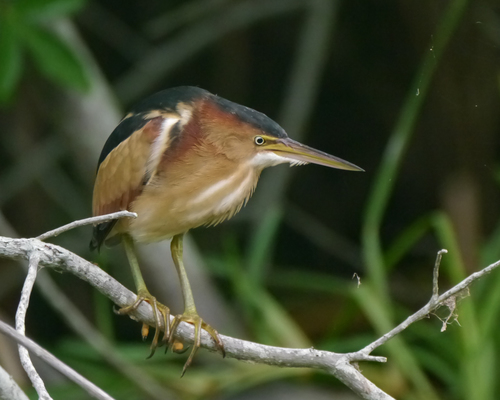
Least Bittern
Botaurus exilis
The Least Bittern is the ultimate marshland ghost—a tiny, acrobatic heron that stalks the reeds with unmatched stealth. Though it is the smallest heron in the Americas, its ability to vanish into the landscape makes it one of the most rewarding sightings for any wildlife enthusiast.
Quick Identification
Size
Length: 11-14 in (28-36 cm); Wingspan: 16-18 in (41-46 cm); Weight: 1.8-3.5 oz (51-99 g)
Colors
Males have a glossy black crown and back with buff wing patches; females are duller with a purple-brown back and streaked throat.
Key Features
- Diminutive size, roughly that of a meadowlark
- Buff-colored wing patches that flash during flight
- Contrasting dark crown and back
- Thin, buffy-white stripes along the sides of the back
- Long, yellow bill and legs
When You’ll See Them
Geographic range
Where Does the Least Bittern Live?
The Least Bittern is a native of the Western Hemisphere, stretching its range from the southern fringes of Canada across the central and eastern United States. This tiny heron is a master of the marshlands, with core populations concentrated throughout the Caribbean, Central America, and significant portions of South America as far south as northern Argentina. While they are year-round residents in tropical regions, those breeding in northern latitudes are highly migratory, seeking out the warmth of the Gulf Coast and South America during the winter months.
Basemap © OpenStreetMap contributors
Behavior
The Least Bittern is one of the most secretive birds in North America, spending the vast majority of its time deep within dense stands of cattails and bulrushes. Unlike larger herons that wade through open water, the Least Bittern is an agile climber. It uses its long toes to grasp reed stalks, effectively 'walking' through the marsh above the water level. When it feels threatened, it performs a classic 'bittern' pose—extending its neck and pointing its bill skyward to blend in with the vertical lines of the marsh vegetation, even swaying gently to mimic reeds blowing in the wind.
Foraging typically happens at the edge of the reeds where the water meets small openings. They are solitary hunters, often staying motionless for long periods before striking at prey with lightning speed. Because of their shy nature and preference for thick cover, they are far more likely to be heard than seen. Their call is a soft, muffled 'coo-coo-coo' that can easily be mistaken for a dove or a distant cuckoo. Interaction with humans is extremely rare, as the bird will usually retreat deeper into the marsh at the first sign of a visitor.
EverydayEarth exclusive
Camera Tips
Capturing the Least Bittern on camera requires a specialized approach because they rarely walk on the ground. To get the best results, mount your camera just 1 to 2 feet above the water level. Position it so the lens is aimed parallel to the edge of a dense reed bed or at a small opening in the cattails. This is where the bittern is most likely to pause and hunt. Using a side-view or an angled placement can help capture their unique behavior of straddling two reed stalks at once.
Since these birds are crepuscular, meaning they are most active during the low light of dawn and dusk, ensure your camera has a high-quality infrared sensor or a fast trigger speed with good low-light sensitivity. Motion blur is a common issue because their striking motion is incredibly fast. If your camera settings allow, prioritize a faster shutter speed even if it means a slightly higher ISO. Because they are shy, avoid frequent visits to the camera; let it sit for a week at a time to allow the birds to return to their normal routines.
You do not need bait for Least Bitterns, as they are strict carnivores that hunt live prey. Instead, focus on 'natural lures' by placing the camera near areas with high concentrations of small minnows or dragonflies. If you have a backyard wetland or pond with heavy vegetation, try clearing a very small 'window' in the reeds (no more than a foot wide) and pointing the camera at that specific gap. They will often use these clearings to look for fish, giving you a perfect, unobstructed shot of this elusive species.
Similar Species
Species that look similar or are commonly confused with Least Bittern.
American Bittern
Much larger and heavier with a thicker neck; lacks the contrasting buff wing patches and black crown of the Least Bittern.
Green Heron
Similar size but much darker overall with a deep green/blue back and chestnut neck; lacks the buffy wing patches and prefers walking on branches over climbing reeds.
Frequently Asked Questions
Record Least Bittern at your habitat
Connect a camera to start building your own species record — AI identifies every visitor automatically.