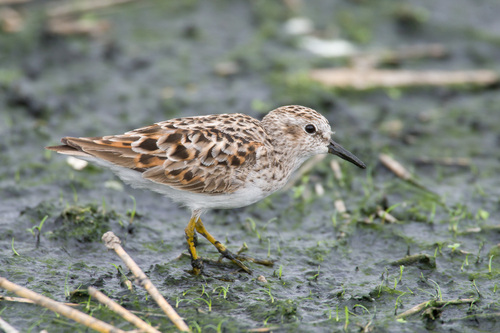
Least Sandpiper
Calidris minutilla
The world's smallest shorebird is a master of migration. Recognizable by its unique yellow legs and hunched posture, the Least Sandpiper is a delightful visitor to mudflats and marshes across the Americas.
Quick Identification
Size
Length: 13-15 cm (5.1-5.9 in); Wingspan: 27-28 cm (10.6-11 in); Weight: 19-30 g (0.7-1.1 oz)
Colors
Brownish-black upperparts with rufous edges; white underparts with a brown-streaked breast; distinctive yellowish-green legs
Key Features
- World's smallest shorebird
- Yellowish-green legs (unlike black legs of similar peeps)
- Thin, short bill with a slight downward droop
- Hunched posture when foraging
When You’ll See Them
Geographic range
Where Does the Least Sandpiper Live?
Native to the North American continent, the Least Sandpiper breeds across the vast subarctic tundra and boreal forests of Alaska and northern Canada. During the winter months, this resilient traveler migrates south to occupy a massive range that includes the southern United States, Mexico, Central America, the Caribbean, and northern South America as far south as Peru and central Brazil. Because they are less dependent on saltwater than other shorebirds, they are frequently found in interior continental stopovers throughout the Midwest and Great Plains during their biannual journeys.
Basemap © OpenStreetMap contributors
Behavior
Least Sandpipers are highly social but somewhat less frantic than their cousins. During migration, they often form large, dense flocks that wheel and turn in unison over wetlands, a behavior meant to confuse predators like Peregrine Falcons. On the ground, they exhibit a characteristic 'hunched' appearance, creeping through the mud with their heads tucked close to their bodies as they probe for food.
Unlike many other shorebirds that prefer the wettest parts of the mudflat or the water's edge, Least Sandpipers are often found higher up in the drier, grassy margins or near patches of vegetation. They are generally more tolerant of human presence than larger waders, allowing careful observers (or well-placed cameras) to get quite close. Their social structure is loose outside of the breeding season, but they frequently associate with other 'peeps' like Semipalmated or Western Sandpipers.
EverydayEarth exclusive
Camera Tips
To capture these tiny shorebirds, camera placement is everything. Because they are the smallest of their kind, a standard tripod height will look down on them, resulting in flat, unengaging photos. Aim to set your camera at 'worm's eye level'—no more than 3 to 6 inches off the ground. This low angle provides an intimate perspective and creates a beautiful, blurred background (bokeh) that makes the bird pop against the mud.
Position your camera near the 'wrack line' or the transition zone where mud meets sparse vegetation. Unlike other shorebirds that stay in the water, Least Sandpipers love to pick through the damp grass and drier mud. If you are using a motion-triggered camera, ensure it has a fast trigger speed and high sensitivity; their small size and quick, jerky movements can sometimes fail to trigger older PIR sensors. A high frame rate or 'burst mode' is essential for catching their fast-paced foraging behavior.
The best time to film is during a rising tide in coastal areas, which pushes the birds closer to the shore and your camera. In inland areas, look for receding water levels in ponds or reservoirs. Early morning light is preferred, as it highlights the subtle rufous and gold edges of their feathers. Avoid baiting, as it is generally ineffective for these insectivores; instead, focus on natural bottlenecks like narrow strips of mud between two pools of water.
Similar Species
Species that look similar or are commonly confused with Least Sandpiper.
Semipalmated Sandpiper
Has black legs and a thicker, straighter bill compared to the yellow-legged Least Sandpiper.
Western Sandpiper
Slightly larger with a longer, more tapered bill and black legs; usually prefers wetter mud than the Least Sandpiper.
Long-toed Stint
A rare Asian visitor that looks very similar but has even longer toes and more contrasting facial markings.
Frequently Asked Questions
Record Least Sandpiper at your habitat
Connect a camera to start building your own species record — AI identifies every visitor automatically.