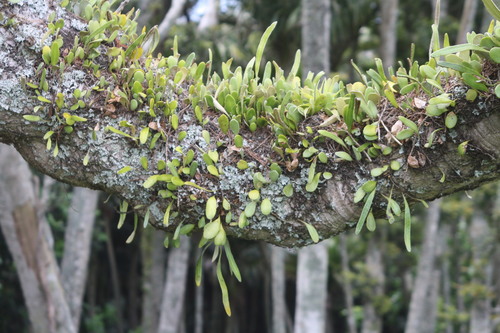
Leather-leaf fern
Pyrrosia eleagnifolia
The ultimate survivor of the New Zealand bush, the Leather-leaf fern is a resilient climber that turns garden walls and tree trunks into lush, green tapestries. Its succulent-like leaves and fuzzy undersides make it a fascinating subject for any backyard explorer.
Quick Identification
Size
Fronds 3-15 cm (1.2-6 in) long; rhizomes can spread several meters (over 6 ft)
Colors
Dark olive-green upper surface; silvery-white to rusty-brown velvety underside
Key Features
- Thick, fleshy, leathery fronds that store water
- Densely fuzzy underside with star-shaped hairs
- Long, scaly, creeping rhizomes for climbing
- Variable leaf shapes from rounded to elongated
When You’ll See Them
Behavior
The Leather-leaf fern is a hardy, climbing epiphyte endemic to New Zealand, famous for its ability to colonize surfaces where other plants struggle. Using its long, scaly rhizomes, it 'crawls' across tree trunks, rocks, and even man-made structures like fence posts and brick walls. This fern is a survivor; its thick, succulent-like leaves allow it to store water, making it far more drought-tolerant than the delicate ferns found in deep forest gullies.
While it doesn't move in the traditional sense, its growth pattern is a slow-motion exploration of its environment. It plays a vital role in suburban biodiversity by creating 'micro-habitats.' The dense mats of foliage trap moisture and organic debris, providing a humid sanctuary for small insects and a hunting ground for native lizards. In a garden setting, it often acts as a natural insulator for the trees it climbs, without causing them any harm.
EverydayEarth exclusive
Camera Tips
To capture the fascinating life of a Leather-leaf fern, set your camera to time-lapse mode. Because this plant is stationary, a standard motion-trigger might not capture it unless a lizard or bird visits. Mount your camera on a fixed post or tripod facing a cluster of the fern on a tree trunk. By taking one photo every few hours over several months, you can create a video that shows the 'crawling' motion of the rhizomes as they expand across the bark—a perspective of plant life rarely seen by the naked eye.
If you are using an AI camera to detect wildlife, the Leather-leaf fern is an ideal 'stage.' Position your camera about 1 meter away from a dense patch of the fern that receives morning sunlight. Native skinks and geckos love to bask on the thick, fleshy leaves to warm up. Set your camera's motion sensitivity to high and aim for a side-on angle. This allows the AI to better distinguish the silhouette of a reptile moving against the textured green background of the fronds.
Pay close attention to lighting and camera settings to highlight the fern's unique texture. The underside of the leaf is covered in star-shaped hairs that look spectacular when backlit by the sun. Try to position your camera so the sun occasionally sits behind the leaves, which will make the edges of the fern glow. At night, ensure your infrared flash isn't too close to the plant, as the reflective 'felt' on the underside of the leaves can cause a bright glare that washes out your images.
Similar Species
Species that look similar or are commonly confused with Leather-leaf fern.
Frequently Asked Questions
Record Leather-leaf fern at your habitat
Connect a camera to start building your own species record — AI identifies every visitor automatically.