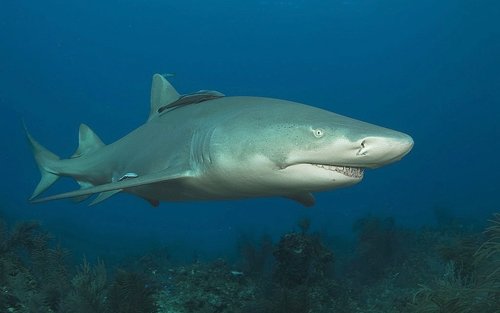
Lemon Shark
Negaprion brevirostris
With their signature sun-kissed hue and social disposition, lemon sharks are the charismatic residents of the world's shallow coastal nurseries.
Quick Identification
Size
Typically 2.4 to 3.1 meters (8 to 10 feet) in length, weighing between 90 and 180 kg (200 to 400 lbs).
Colors
Yellowish-brown to olive-gray on the dorsal side, providing camouflage against sandy seafloors, with a starkly pale yellow or white underbelly.
Key Features
- Two dorsal fins of nearly equal size
- Broad, blunt snout shorter than the width of the mouth
- Distinctive yellowish tint to the skin
- Stocky build with small, narrow eyes
When You’ll See Them
Geographic range
Where Does the Lemon Shark Live?
Lemon sharks are primarily found in the tropical and subtropical waters of the Atlantic and Eastern Pacific Oceans. Their core range extends along the coastlines of North and South America, from New Jersey down to southern Brazil, including the densely populated Caribbean Sea and the Gulf of Mexico. In the Eastern Pacific, they can be spotted from the Gulf of California down to Ecuador, while a separate population inhabits the western coast of Africa.
Basemap © OpenStreetMap contributors
Behavior
Lemon sharks are highly social creatures, a trait somewhat rare among sharks. They are often found in loose aggregations, particularly as juveniles, where they exhibit complex social behaviors and learn from one another. Unlike many shark species that must swim constantly to breathe, lemon sharks can remain still on the seafloor, using buccal pumping to move water over their gills.
These sharks are primarily nocturnal or crepuscular hunters, becoming most active as the sun sets. While they are powerful predators, they are generally not considered a high threat to humans; most recorded interactions are the result of the shark being spooked or provoked. Interestingly, they demonstrate high site fidelity, often returning to the same specific mangrove nurseries to give birth.
EverydayEarth exclusive
Camera Tips
Capturing a lemon shark on camera requires an underwater setup, ideally positioned near a natural bottleneck like a canal entrance or a gap in a coral reef. If you live on a coastal property with a dock, mounting a waterproof 'drop-cam' or a trail camera in a specialized underwater housing to one of the pilings is the most effective method. Aim the camera downward at a 45-degree angle toward the sandy bottom where these sharks often cruise or rest.
Lighting is the biggest challenge for underwater captures. Since lemon sharks are most active during twilight and night, use a camera with high-quality infrared (IR) capabilities or a motion-activated external submersible light. However, be aware that bright white lights can sometimes startle the fish, so a soft, diffused light source often yields more natural behavior and clearer footage of their distinctive yellow skin.
Placement is key: look for 'shark highways'—areas of moving water during tide changes. In 'backyard' coastal settings, the hours surrounding high tide are usually the most productive, as the increased water depth allows larger sharks to move closer to shore and into mangrove fringes. Ensure your housing is regularly cleaned of biofouling (algae and barnacles) to keep your lens clear for that perfect shot.
Similar Species
Species that look similar or are commonly confused with Lemon Shark.
Frequently Asked Questions
Record Lemon Shark at your habitat
Connect a camera to start building your own species record — AI identifies every visitor automatically.