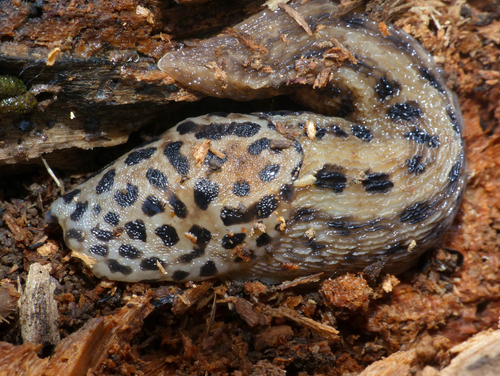
Leopard Slug
Limax maximus
The Leopard Slug is nature's most stylish 'cleaner,' sporting striking spots and performing high-wire mating acrobatics in the dark of night. Unlike common garden pests, this beneficial predator helps balance your backyard ecosystem by hunting other slugs and recycling nutrients.
Quick Identification
Size
Typically 10-20 cm (4-8 inches) in length; weight is negligible but they are among the largest land slugs.
Colors
Pale grey, tan, or yellowish-brown base color; the mantle (the 'shield' near the head) is covered in black spots, while the tail has longitudinal black stripes or dashes.
Key Features
- Distinctive leopard-like black spots and stripes
- Large, muscular body with a prominent ridge or 'keel' at the tail
- Retractable upper tentacles with eyes at the tips
- Produces a thick, clear slime trail
When You’ll See Them
Geographic range
Where Does the Leopard Slug Live?
Native to the temperate forests and fields of Europe, North Africa, and Asia Minor, the Leopard Slug has become a successful global traveler. It is now widely established across North America, from southern Canada throughout the United States, as well as in parts of South America, Australia, and New Zealand. This adaptable mollusk thrives wherever humans have created moist garden environments, making it a common sight in backyard ecosystems across the globe.
Basemap © OpenStreetMap contributors
Behavior
The Leopard Slug is a solitary and highly territorial invertebrate that is most famous for its extraordinary mating ritual. Unlike most garden inhabitants, these slugs are surprisingly fast-moving and exhibit a 'homing' behavior, returning to the same damp crevice or sheltered spot every day after their nocturnal foraging. While many consider slugs to be pests, the Leopard Slug is actually a beneficial presence in the garden, as it often preys on other slug species and focuses its diet on decaying organic matter rather than healthy living plants.
When it comes to social interaction, they are mostly solitary except during mating. Their reproduction is a spectacular sight: a pair will climb a tree or wall, entwine their bodies, and lower themselves on a thick thread of mucus to mate in mid-air. This acrobatic display can last for hours and is one of the most unique behaviors in the backyard world. They are harmless to humans, though their thick mucus can be difficult to wash off skin.
EverydayEarth exclusive
Camera Tips
Capturing the Leopard Slug on camera requires a different approach than traditional wildlife. Because they move slowly and stick to the ground, you should place your camera at the lowest possible angle. Use a 'ground-stake' mount or prop the camera on a brick. Focus is critical; if your camera has a macro mode or adjustable focus, set it for a close-range trigger (within 1-2 feet) to capture the intricate marbling of their skin.
Since they are strictly nocturnal, you will rely entirely on your camera's infrared (IR) sensors. Leopard Slugs are highly attracted to moisture and scent. You can 'bait' a specific spot by placing a damp piece of old plywood on the ground or a small pile of overripe fruit or mushroom caps. Placing your camera near a compost bin or a leaky outdoor faucet is almost a guaranteed way to see them in action during the summer months.
To capture their famous mating ritual, look for vertical surfaces. Point your camera at a wooden fence, a brick wall, or the trunk of a large tree about 3 to 5 feet off the ground. If you see two slugs following each other's slime trails (a behavior called 'tracking'), there is a high chance they are about to begin their aerial display nearby. Use a time-lapse setting with a 30-second interval to turn their slow-motion world into a fascinating short film.
Similar Species
Species that look similar or are commonly confused with Leopard Slug.
Frequently Asked Questions
Record Leopard Slug at your habitat
Connect a camera to start building your own species record — AI identifies every visitor automatically.