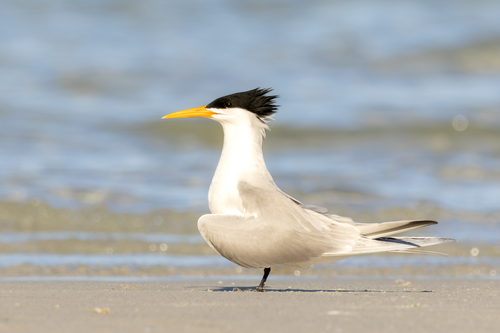
Lesser Crested Tern
Thalasseus bengalensis
An elegant master of the coastline, the Lesser Crested Tern is instantly recognizable by its shock of black hair and vibrant orange bill. Whether diving for fish or socialising on the sand, this bird is a coastal icon.
Quick Identification
Size
Length: 35-43 cm (14-17 in); Wingspan: 88-105 cm (35-41 in); Weight: 185-242 g (6.5-8.5 oz)
Colors
Pale grey upperparts and white underparts; solid bright orange bill; black cap with a shaggy crest; black legs
Key Features
- Slender, bright orange bill
- Shaggy black crest at the back of the crown
- Pale grey mantle and wings
- Deeply forked tail and black legs
- White forehead during the non-breeding season
When You’ll See Them
Geographic range
Where Does the Lesser Crested Tern Live?
The Lesser Crested Tern is native to the tropical and subtropical coastal regions of the Old World, with its most significant populations found along the shores of the Indian Ocean and the western Pacific. Its core range extends from the Red Sea and the Persian Gulf through India and Southeast Asia to the northern and eastern coasts of Australia. Smaller, distinct populations also inhabit the Mediterranean coast of Libya and the Atlantic coast of Mauritania, making it a truly wide-ranging maritime specialist.
Basemap © OpenStreetMap contributors
Behavior
The Lesser Crested Tern is a highly social and vocal seabird, almost always found in the company of its own kind or other tern species. They are famous for their acrobatic fishing displays, which involve hovering briefly over the water's surface before performing a vertical plunge-dive to snatch small fish. During the breeding season, they gather in massive, dense colonies on offshore islands, where their synchronized nesting helps protect against predators.
Outside of nesting, these birds are quite nomadic, wandering along coastlines in search of productive fishing grounds. They are often seen resting on sandy spits, breakwaters, or boat docks between hunting forays. While they are generally wary of humans, they have learned to take advantage of human-altered environments, frequently following fishing boats to pick up discarded bycatch or gathering near coastal piers where baitfish congregate.
EverydayEarth exclusive
Camera Tips
To successfully capture a Lesser Crested Tern on your backyard or trail camera, location is everything. Since these birds are strictly coastal, your camera must be positioned near the water's edge. Look for frequented perches such as private docks, pier railings, or even large driftwood logs on the beach. Mount your camera at a height of 3 to 5 feet, but ensure it is angled slightly upward to account for the bird's tall, upright posture when perched and to catch the action if they take flight.
Because these birds are visual hunters, traditional baits like seeds or suet will not work. Instead, try placing your camera near areas where natural activity is high, such as tidal pools that trap small fish or near local fishing spots where they may come to investigate activity. If you have a private pier, mounting a camera near a fish-cleaning station (while keeping the device out of the splash zone) can provide incredible close-up opportunities as they look for scraps.
Settings are crucial for capturing these fast-moving birds. Set your camera to its fastest trigger speed and use a multi-shot burst mode. This ensures that even if the bird is just 'passing through' or diving into the frame, you get at least one clear shot. High-resolution video can also be rewarding, as it captures the distinctive shaggy crest fluttering in the sea breeze. Since they are most active during the golden hours of early morning and late afternoon, ensure your camera's exposure settings are optimized for bright, reflective coastal light to avoid washing out their white plumage.
Similar Species
Species that look similar or are commonly confused with Lesser Crested Tern.
Frequently Asked Questions
Record Lesser Crested Tern at your habitat
Connect a camera to start building your own species record — AI identifies every visitor automatically.