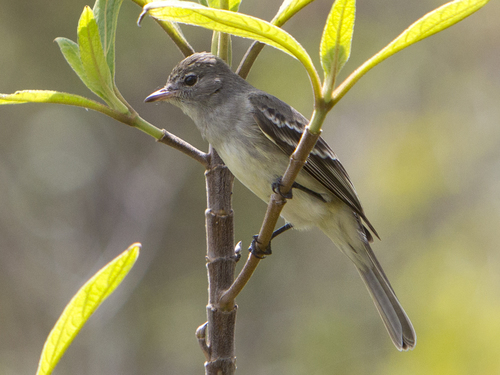
Lesser Elaenia
Elaenia chiriquensis
A small bird with a buzzy personality, the Lesser Elaenia is a master of the 'sally-strike' hunt. Recognized by its subtle crest and two white wing bars, it is a frequent and lively visitor to gardens across the American tropics.
Quick Identification
Size
13–14 cm (5–5.5 inches) in length; weighs approximately 12–16 g (0.4–0.6 oz)
Colors
Dull olive-brown upperparts with a grayish-white throat and breast. The belly is a pale, washed-out yellow. It features two white wing bars and a small crest that occasionally reveals a white hidden crown patch.
Key Features
- Two distinct white wing bars
- Small, bushy crest often showing a white center
- Pale yellow belly and grayish throat
- Small, dark bill with a flesh-colored base on the lower mandible
- Distinctive buzzy 'wee-wee-ree' call
When You’ll See Them
Geographic range
Where Does the Lesser Elaenia Live?
This resilient flycatcher is native to Central and South America, spanning a massive territory from Costa Rica and Panama down through the Amazon basin into northern Argentina and Paraguay. It is a common sight across the Brazilian Cerrado and the Colombian llanos, thriving in almost every South American nation except for the southern reaches of Chile and Uruguay. While primarily a resident, southern populations are known to migrate northward toward the equator during the austral winter.
Basemap © OpenStreetMap contributors
Behavior
The Lesser Elaenia is a spirited member of the tyrant flycatcher family, known for its active and somewhat territorial nature. Unlike some of its more reclusive relatives, this bird often perches in open, prominent spots atop shrubs or low trees to survey its surroundings. While it is typically solitary or found in pairs, it makes its presence known through its characteristic buzzy, wheezing calls that carry well across open terrain.
Its feeding habits are a mix of athletic aerial maneuvers and methodical gleaning. You will often see it 'sallying' out from a perch to snatch an insect mid-air before returning to the same spot. In addition to its fly-catching prowess, it is quite fond of small berries, often hovering momentarily to pluck fruit from the tips of branches. In human-altered landscapes, it adapts remarkably well to suburban gardens and parks, provided there is enough brushy cover and fruiting vegetation.
EverydayEarth exclusive
Camera Tips
To capture the Lesser Elaenia on your backyard AI camera, focus your setup on mid-level perches rather than the ground. These birds love 'sallying' points—exposed, horizontal branches about 4 to 8 feet off the ground that offer a clear view of the surrounding air for hunting insects. Position your camera on a tripod or fence post facing a favorite perch near a fruiting shrub like Miconia or a berry-laden hedge. Since they are fast movers, a camera with a high shutter speed or 'Action' mode is vital to avoid motion blur during their quick aerial maneuvers.
Water is a major draw for this species. Placing your camera near a birdbath or a shallow dripping water feature is one of the most effective ways to get clear, stationary shots. They prefer to bathe in the early morning or late afternoon when the light is softer. Angle the camera slightly downward toward the water's edge to capture the bird's unique head shape and crest, which it often flares while drying its feathers after a bath.
If your camera supports motion triggers, set the sensitivity to high. The Lesser Elaenia is small and moves with sudden, jerky motions, so a fast trigger speed (under 0.5 seconds) is ideal to catch it before it flies out of the frame. During the nesting season, they may be attracted to nesting materials; placing a small basket of cotton or short bits of twine within view of the camera can provide unique behavioral footage as they gather materials for their cup-shaped nests.
Similar Species
Species that look similar or are commonly confused with Lesser Elaenia.
Yellow-bellied Elaenia
Larger with a much more prominent, bushy crest and a louder, clearer whistling call.
Plain-crested Elaenia
Lacks the hidden white crown patch and generally inhabits more arid, open scrubland habitats.
Small-billed Elaenia
Very similar in appearance but has three wing bars instead of two and a different, more melodic song.
Frequently Asked Questions
Record Lesser Elaenia at your habitat
Connect a camera to start building your own species record — AI identifies every visitor automatically.