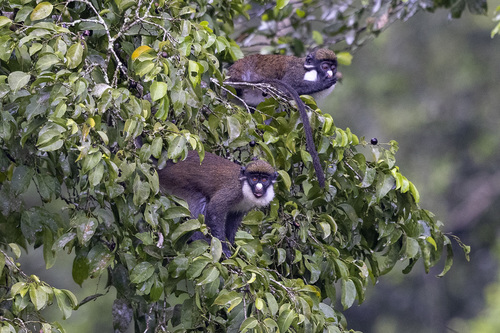
Lesser Spot-nosed Monkey
Cercopithecus petaurista
Meet West Africa’s heart-nosed acrobat. The Lesser Spot-nosed Monkey is a social canopy-dweller famous for its striking facial markings and incredible agility in the treetops.
Quick Identification
Size
Body length 35-45 cm (14-18 in) with a tail reaching 55-70 cm (22-28 in); weight ranges from 2-4 kg (4.4-8.8 lbs).
Colors
Olive-brown or greyish back with a pale yellowish-white underbelly; distinctive bright white heart-shaped spot on the nose; blue-grey skin around the eyes.
Key Features
- Bright white, heart-shaped spot on the nose
- Extremely long, thin reddish-brown tail
- Blue-grey skin circles around the eyes
- White or pale yellow throat and chest
When You’ll See Them
Geographic range
Where Does the Lesser Spot-nosed Monkey Live?
Native to the tropical regions of West Africa, the Lesser Spot-nosed Monkey is a signature species of the Upper Guinean forest block. Its range extends from the coastal forests of Guinea-Bissau and Sierra Leone through Liberia and Ivory Coast, reaching as far east as the Volta River in Ghana and Togo. They are forest specialists that thrive in areas where the canopy is dense enough to provide safe travel routes away from ground-based threats.
Basemap © OpenStreetMap contributors
Behavior
The Lesser Spot-nosed Monkey is a highly social and agile primate that lives in cohesive groups of 10 to 30 individuals. These troops are usually led by a single dominant male and consist of several adult females and their dependent offspring. They are known for being extremely vocal, using a complex system of 'pyow' and 'hack' calls to communicate within the troop and warn of approaching predators like leopards or crowned eagles.
These monkeys are predominantly arboreal, spending most of their lives in the forest canopy. They are remarkably active during the day and are often found in 'polyspecific' associations, meaning they travel and forage alongside other monkey species, such as Diana monkeys. This behavior is thought to improve their chances of spotting predators and finding patchy food sources in the dense West African rainforests.
EverydayEarth exclusive
Camera Tips
To successfully capture the Lesser Spot-nosed Monkey on a trail camera, you must think vertically. These primates rarely descend to the forest floor except to cross narrow gaps or visit low-hanging fruit. For the best results, mount your camera at a height of 3 to 6 meters (10 to 20 feet) on a tree that overlooks a 'primate highway'—a horizontal branch or a tangle of vines that provides a natural bridge between trees.
Position your camera to face slightly downward toward these branches. If you are operating on a private property or forest edge where they are known to visit, you can encourage them to pause by identifying their favorite seasonal fruiting trees. Placing a camera near a ripening wild fig or oil palm can yield fantastic results as the whole troop will take turns feeding in that specific spot. Use a high-speed trigger and a multi-shot burst mode, as these monkeys move with incredible speed and agility.
Lighting is a major factor in the deep forest. If your camera is under a thick canopy, ensure your settings allow for a higher ISO or use a model with a high-quality infrared flash for low-light morning hours. During the rainy season, look for spots where the sun breaks through the canopy in the late afternoon; monkeys will often seek out these sun-drenched branches to dry their fur and groom one another, providing excellent opportunities for clear, high-contrast photos.
Similar Species
Species that look similar or are commonly confused with Lesser Spot-nosed Monkey.
Frequently Asked Questions
Record Lesser Spot-nosed Monkey at your habitat
Connect a camera to start building your own species record — AI identifies every visitor automatically.