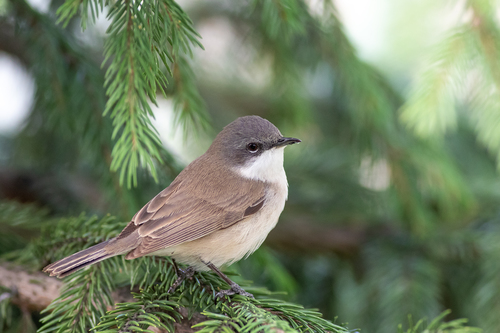
Lesser Whitethroat
Curruca curruca
A master of the thicket, the Lesser Whitethroat is a subtle beauty known for its distinctive dark mask and mechanical rattling song. This elusive traveler brings a touch of wild mystery to backyard hedgerows every spring.
Quick Identification
Size
Length: 11.5–13.5 cm (4.5–5.3 in); Wingspan: 16–20 cm (6.3–7.9 in); Weight: 10–16 g (0.35–0.56 oz)
Colors
Grey head with darker ear-coverts forming a 'mask', bright white throat, brownish-grey upperparts, and pale greyish-white underparts. Both sexes look identical.
Key Features
- Distinctive dark grey 'thief mask' through the eyes
- Bright, contrasting white throat
- Lead-grey legs and feet
- Lacks the rufous wing patches of its larger cousin, the Common Whitethroat
When You’ll See Them
Geographic range
Where Does the Lesser Whitethroat Live?
Native to the temperate regions of Europe and the western Palearctic, the Lesser Whitethroat is a seasonal resident across much of the continent except for the far southwest. Its core breeding range spans from the United Kingdom and southern Scandinavia through Central Europe and into Central Asia. As a dedicated migrant, the entire population moves south in autumn, wintering in a broad belt across East Africa, the Arabian Peninsula, and the Indian subcontinent.
Basemap © OpenStreetMap contributors
Behavior
The Lesser Whitethroat is a notably shy and secretive warbler, often described as a 'skulker.' Unlike its bolder relatives, it prefers to stay deep within dense, thorny vegetation or thick hedgerows, making it much easier to hear than to see. It has a very distinctive song—a repetitive, mechanical 'rattle' that carries well across gardens and farmland, usually delivered from the safety of a thick bush.
During the breeding season, these birds are highly territorial but remain elusive. They move with agile, jerky hops through branches, searching for small insects. While they are solitary during the summer, they may join loose mixed-species flocks during their impressive long-distance migrations, where they travel thousands of miles to reach their wintering grounds.
EverydayEarth exclusive
Camera Tips
To capture a Lesser Whitethroat on camera, you must focus on their love for dense cover. Unlike garden birds that sit out in the open, these warblers prefer to stay 'inside' the bush. Position your camera about 3 to 4 feet off the ground, aiming directly at a small gap or a popular 'corridor' within a thick hedge or a stand of brambles. Because they are fast-moving, a camera with a high-speed trigger (under 0.2 seconds) and a high frame rate for video is essential to avoid capturing just a blurry tail.
While they don't typically visit traditional seed feeders, they are highly attracted to water, especially during hot spells in May and June. A birdbath placed very close to (or even slightly tucked into) a shrubby area is your best chance for a clear shot. Ensure the camera is set to a wide-angle focus if possible, as these birds will often land just inches from the lens if it is well-camouflaged within the foliage.
In late summer (August and September), you can lure them into view by focusing your camera on berry-bearing bushes like elderberry or spindle. They become much more focused on feeding during this time as they prepare for migration. Use a 'fast' shutter speed setting if your camera allows it, as their foraging movements are jerky and sudden. Early morning light is best, as this is when they are most active and their grey-and-white contrast shows up most clearly against the green leaves.
Similar Species
Species that look similar or are commonly confused with Lesser Whitethroat.
Frequently Asked Questions
Record Lesser Whitethroat at your habitat
Connect a camera to start building your own species record — AI identifies every visitor automatically.