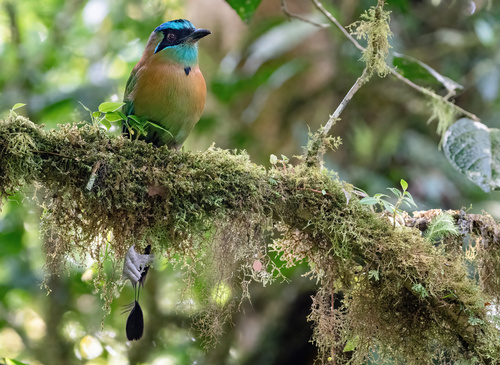
Lesson's Motmot
Momotus lessonii
The 'pendulum of the forest,' Lesson's Motmot is famous for its stunning turquoise crown and a unique racket-tipped tail that swings like a clock.
Quick Identification
Size
38–48 cm (15–19 in) in length; Weight 115–150g (4–5.3 oz)
Colors
Olive-green body with a rufous-washed chest; black mask edged with blue; striking turquoise-blue ringed crown; black center to the crown; long tail with blue racket-tips
Key Features
- Large racket-tipped tail feathers
- Bright turquoise 'diadem' ring on the head
- Thick black mask through the eyes
- Serrated heavy beak
- Pendulum-like tail swinging motion
When You’ll See Them
Geographic range
Where Does the Lesson's Motmot Live?
Lesson's Motmot is native to the tropical and subtropical regions of Central America. Its core range extends from southern Mexico—specifically the states of Veracruz and Chiapas—downward through the Pacific and Caribbean slopes of Guatemala, Belize, Honduras, El Salvador, Nicaragua, and Costa Rica, reaching its southern limit in western Panama. Within this region, it is a common resident that does not migrate, though it may move locally between different elevations depending on food availability.
Basemap © OpenStreetMap contributors
Behavior
Lesson's Motmot is a 'perch-and-wait' predator, often sitting motionless for long periods on shaded branches while scanning the ground or foliage for prey. When it detects movement, it dart out in a sudden burst of speed to snatch insects, small lizards, or fruit. One of its most distinctive behaviors is the 'pendulum' tail wag, where it rhythmically swings its long tail from side to side when it senses a predator or a human nearby—a signal intended to let the intruder know they have been spotted.
These birds are socially monogamous and highly territorial. They are unique among birds for their nesting habits, as they excavate long, winding burrows in earth banks, often along roadsides, riverbanks, or even in the soil of large garden planters. While they can be shy, they are often quite tolerant of human presence if provided with enough canopy cover and are a common sight in shaded coffee plantations and mature suburban gardens throughout their range.
EverydayEarth exclusive
Camera Tips
To capture Lesson's Motmot on camera, placement is everything. These birds prefer horizontal, shaded branches that offer a clear view of the ground below. Set your camera at a height of 5 to 8 feet, angled slightly downward toward a likely perching spot or a patch of leaf litter where they might forage. Because they sit still for long periods, use a high-sensitivity trigger setting or, better yet, a time-lapse mode with short intervals to ensure you don't miss them during their 'statue' phase.
Video mode is highly recommended for this species. The most fascinating aspect of Motmot behavior is the rhythmic swinging of their racket-tipped tail. A 15-30 second video clip is much more likely to capture this unique 'pendulum' motion than a still photo. If you are setting up in a backyard, placing your camera near a birdbath or a consistent water drip in a shaded area is a winning strategy, as they are frequent bathers in the heat of the afternoon.
During the dry season (December through April), you can attract them toward your camera's field of view by planting native fruiting trees like wild figs or by providing a platform feeder with halved papayas or bananas. However, they are more attracted to the insects that the fruit draws in than the fruit itself. If you notice holes in earthen banks on your property, place a camera about 10 feet away facing the entrance during the spring; this is likely a nesting site, and you'll capture amazing footage of them bringing prey to their chicks.
Similar Species
Species that look similar or are commonly confused with Lesson's Motmot.
Turquoise-browed Motmot
Smaller with prominent turquoise 'eyebrows' instead of a full crown ring; favors drier habitats.
Blue-capped Motmot
Found further north in Mexico; has a slightly different shade of blue on the crown and distinct vocalizations.
Whooping Motmot
Native to central Panama and South America; has a distinct 'whoop' call compared to the 'hoot-hoot' of Lesson's.
Frequently Asked Questions
Record Lesson's Motmot at your habitat
Connect a camera to start building your own species record — AI identifies every visitor automatically.