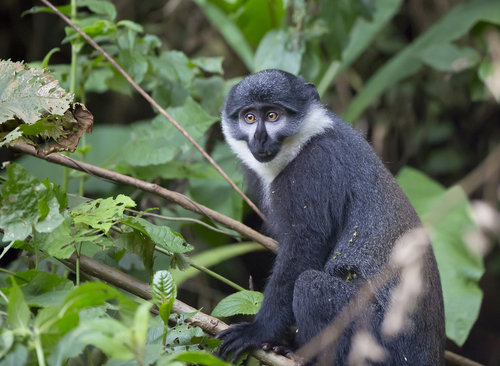
L'Hoest's Monkey
Allochrocebus lhoesti
The L'Hoest's monkey is a regal, white-bearded primate that rules the forest floors of the Albertine Rift. Known for their striking chestnut 'saddles' and terrestrial lifestyle, these monkeys are a rare and beautiful sight in Africa's high-altitude jungles.
Quick Identification
Size
Body length 45–60 cm (18–24 in), tail length up to 100 cm (39 in); Weight 4.5–10 kg (10–22 lbs)
Colors
Dark charcoal to black body with a prominent chestnut-brown saddle on the back and a thick, snow-white ruff around the neck and ears.
Key Features
- Striking white beard and throat ruff
- Chestnut-brown saddle patch on the lower back
- Long, dark tail with a slightly hooked tip
- Deep orange or amber-colored eyes
When You’ll See Them
Geographic range
Where Does the L'Hoest's Monkey Live?
L'Hoest's monkey is native to the lush, mountainous landscapes of the upper eastern Congo Basin in Central and East Africa. Its core range is concentrated within the Albertine Rift, spanning the high-elevation forests of the eastern Democratic Republic of the Congo, southwestern Uganda, Rwanda, and Burundi. These monkeys thrive in the cool, moist conditions of protected national parks like Bwindi Impenetrable and Nyungwe, where they are restricted to fragmented pockets of primary and secondary montane forest.
Basemap © OpenStreetMap contributors
Behavior
L'Hoest's monkeys are uniquely adapted guenons that spend a significant amount of their time on the forest floor rather than in the high canopy. They are highly social animals, living in groups of 10 to 17 individuals led by a single dominant male and a core group of related females. Their terrestrial nature makes them incredibly agile on the ground, where they use the dense undergrowth for protection and foraging.
While they are generally shy and elusive when encountering humans, they are remarkably vocal within their groups, using a series of chirps and barks to coordinate movement through the forest. When a predator is detected, the troop usually freezes or slips quietly into the thickest vegetation rather than climbing, a behavior that distinguishes them from many of their arboreal cousins. In areas where they have become accustomed to research presence, they display high levels of curiosity and complex social grooming rituals.
EverydayEarth exclusive
Camera Tips
To capture high-quality footage of L'Hoest's monkeys, camera placement is key. Unlike most primates that require canopy-mounted units, these monkeys are semi-terrestrial. Mount your camera at a height of 0.5 to 1 meter (1.5 to 3 feet) off the ground, targeting natural clearings, game trails, or the base of large fruiting trees where they are likely to forage for fallen snacks. Because they are often shy, ensure your camera uses 'No-Glow' or 'Black' infrared LEDs to prevent scaring the troop with visible red light during early morning or late afternoon shots.
If you are deploying cameras in a backyard or garden setting near their forest habitat, you can encourage them to linger by providing a safe, quiet space with natural cover. While they are attracted to fallen fruit, they are cautious; placing the camera near a water source or a large log used for grooming can result in more intimate, social footage. Always use a high-speed SD card and set the trigger speed to the fastest possible setting (0.3s or less), as these monkeys move surprisingly fast through the undergrowth and can easily pass the frame before a slow sensor reacts.
Because L'Hoest's monkeys travel in cohesive troops, set your camera to 'Burst' or 'Multi-shot' mode. The dominant male often brings up the rear or stays on the periphery, so capturing multiple photos ensures you see the whole family rather than just the first juvenile to run past. If you are monitoring them during the rainy season, use a protective housing or rain shield, as the misty mountain air can cause lens fogging that obscures their distinct white ruff.
Similar Species
Species that look similar or are commonly confused with L'Hoest's Monkey.
Frequently Asked Questions
Record L'Hoest's Monkey at your habitat
Connect a camera to start building your own species record — AI identifies every visitor automatically.