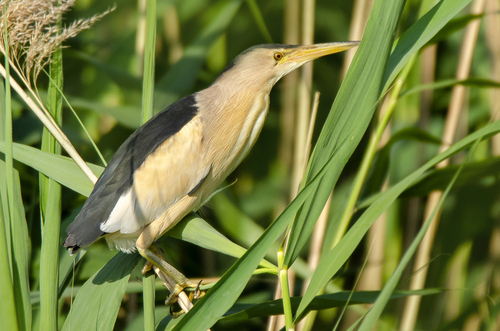
Little Bittern
Botaurus minutus
A tiny master of disguise, the Little Bittern is the smallest heron in its range, expertly blending into reedbeds with its remarkable camouflage. Catching a glimpse of this secretive bird is a badge of honor for any backyard wildlife enthusiast with a wetland nearby.
Quick Identification
Size
Length 27–36 cm (11–14 in), wingspan 40–58 cm (16–23 in), weight 60–150 g (2–5 oz)
Colors
Males have a black crown and back with creamy-buff wing patches; females are browner with streaked underparts.
Key Features
- Smallest European heron with a pigeon-sized body
- Striking pale buff wing patches visible in flight
- Secretive 'freezing' posture with neck extended vertically
- Black crown and mantle contrasting with pale neck (males)
When You’ll See Them
Geographic range
Where Does the Little Bittern Live?
The Little Bittern boasts a wide native range spanning across Europe, Western Asia, and Africa. During the breeding season, they are found throughout central and southern Europe and parts of the Middle East, with these northern populations migrating to Sub-Saharan Africa for the winter. Resident populations that stay put year-round are commonly found in various parts of southern Africa and southern Asia, making them a truly international wetland inhabitant.
Basemap © OpenStreetMap contributors
Behavior
The Little Bittern is a master of stealth, spending the majority of its life hidden within the dense vegetation of reedbeds. Unlike its larger relatives, it is more active during the dawn and dusk hours (crepuscular), though it can be seen hunting during the day if the area remains undisturbed. When it senses a threat, it adopts a classic 'bittern posture,' stretching its neck and bill toward the sky to mimic the surrounding reeds and become nearly invisible.
These birds are primarily solitary and highly territorial during the breeding season. They are remarkably agile, often seen climbing or 'walking' through reed stems using their long, articulated toes to grip the stalks rather than wading in open water. While they generally avoid human interaction, they may tolerate proximity if they feel adequately concealed by their marshy habitat.
EverydayEarth exclusive
Camera Tips
Capturing the Little Bittern on camera requires patience and strategic placement, as they rarely venture into open spaces. Position your camera at the very edge of a reedbed where the vegetation meets a small muddy clearing or a pocket of open water. The lens should be mounted low—roughly 30 to 50 centimeters above the water level—to catch their eye-level movements as they stalk through the stalks. Ensure the camera is angled slightly upward if the reeds are tall, focusing on the narrow 'lanes' where they move.
Since these birds are most active during the low-light hours of dawn and dusk, a camera with high-quality infrared or 'no-glow' LEDs is essential to avoid spooking them while maintaining image clarity. Look for trail cameras with a fast trigger speed (0.3 seconds or less), as their striking motion when catching prey is lightning-fast. You don't need artificial lures or bait; instead, look for natural 'corridors' in the vegetation or flat logs near the water's edge where they might pause to scout for fish.
During the breeding season, listen for the males' repetitive, rhythmic 'barking' calls to locate their specific territory. Set your camera to record short video clips (15-20 seconds) rather than just photos; this allows you to observe their unique reed-climbing behavior and the incredible 'swaying' motion they use to mimic wind-blown plants. Avoid disturbing the nesting site directly, as they are sensitive to changes in their immediate environment and may abandon the area if they feel exposed.
Similar Species
Species that look similar or are commonly confused with Little Bittern.
Frequently Asked Questions
Record Little Bittern at your habitat
Connect a camera to start building your own species record — AI identifies every visitor automatically.