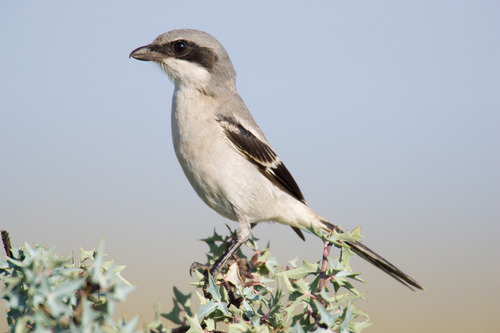
Loggerhead Shrike
Lanius ludovicianus
Meet the 'butcherbird,' a masked hunter that uses thorns as tools. The Loggerhead Shrike is a master of the open field, combining the grace of a songbird with the precision of a raptor.
Quick Identification
Size
Length: 20–23 cm (8–9 in); Wingspan: 28–32 cm (11–13 in); Weight: 35–50 g (1.2–1.8 oz)
Colors
Bluish-grey back and head, white underparts, black wings and tail with white flashes, and a thick black mask that extends through the eye.
Key Features
- Thick black mask across eyes
- Hooked raptor-like beak
- Large, blocky head
- White patches on black wings visible in flight
- Grey back with contrasting white throat
When You’ll See Them
Sightings on EverydayEarth
Jul 15, 2026
A Loggerhead Shrike lands on the outer branches of the large stick nest, hopping actively between the sun-bleached sticks as it surveys the surrounding brush.
Jul 1, 2026
A Loggerhead Shrike is perched on the edge of the large stick nest, which belongs to a pair of Bald Eagles. The bird remains alert, scanning the surrounding hillside and occasionally shifting its position before flying away.
Geographic range
Where Does the Loggerhead Shrike Live?
This fascinating predatory songbird is native exclusively to the North American continent, holding the title of the only shrike species endemic to this region. Its core range spans from the southern prairies of Canada, across the vast majority of the United States, and down into the Mexican plateau. While once common throughout the Northeast and Midwest, they are now most frequently spotted in the southern United States and Mexico, where open grasslands and warm climates support their year-round hunting needs.
Basemap © OpenStreetMap contributors
Behavior
The Loggerhead Shrike is a songbird that behaves like a hawk, earning it the evocative nickname 'butcherbird.' Because it lacks the powerful talons of a true raptor, it has evolved a unique and somewhat gruesome hunting strategy: it impales its prey on sharp objects like thorns, honey locust spikes, or barbed wire. This 'larder' allows the bird to secure its meal while using its hooked beak to tear into it, and also serves as a storage site for future consumption.
These birds are highly territorial sit-and-wait predators. You will often see them perched stoically on high wires, fence posts, or the outer branches of trees, scanning the ground for movement. When they spot a target, they dive with incredible speed and precision. Despite their fierce reputation, they are social within their family units and can be seen performing aerial displays during the breeding season.
EverydayEarth exclusive
Camera Tips
Capturing a Loggerhead Shrike on camera requires focusing on their 'larder' sites. Look for sections of barbed wire or thorny bushes like Hawthorn or Honey Locust on the edge of an open field. If you see a grasshopper or lizard impaled on a thorn, you’ve found the perfect spot. Mount your camera 3 to 5 feet off the ground, aimed directly at these 'meat hooks,' as the shrike is almost certain to return to its stored meal.
Because shrikes are sit-and-wait hunters, they love high, isolated vantage points. If you have a lone fence post or a dead snag in an open area, this is an ideal mounting location. Place the camera a few feet back from the perch to ensure the bird’s wide wingspan is captured when it takes off or lands. Use a fast trigger speed setting, as their movements from perch to ground are lightning-fast.
To encourage them to visit your camera's field of view, avoid using pesticides in your yard; shrikes are drawn to areas with high populations of large insects and small reptiles. In terms of settings, use 'burst mode' or short video clips. A shrike's behavior—flicking its tail or adjusting its prey—is much better captured in motion or a sequence of stills than in a single shot. Early morning light provides the best clarity for capturing the subtle grey tones of their plumage.
Similar Species
Species that look similar or are commonly confused with Loggerhead Shrike.
Frequently Asked Questions
Record Loggerhead Shrike at your habitat
Connect a camera to start building your own species record — AI identifies every visitor automatically.