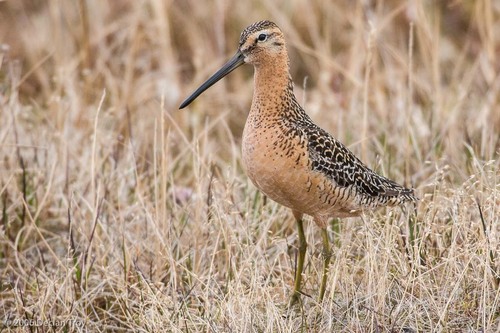
Long-billed Dowitcher
Limnodromus scolopaceus
A master of the marshes, the Long-billed Dowitcher is easily recognized by its rapid 'sewing machine' feeding style and impressive profile. This Arctic traveler brings a touch of wild tundra beauty to backyard wetlands during its incredible continental migrations.
Quick Identification
Size
Length: 27–30 cm (10.6–11.8 in); Wingspan: 46–52 cm (18–20 in); Weight: 90–120 g (3.2–4.2 oz)
Colors
Breeding adults have rufous (reddish-orange) underparts and necks with dark barring on the sides. Non-breeding plumage is a drab grayish-brown. Both phases feature a white cigar-shaped patch on the lower back.
Key Features
- Extremely long, straight bill often twice the length of the head
- Rapid, vertical 'sewing machine' probing motion while feeding
- White wedge-shaped patch on the lower back visible during flight
- Dull yellowish or greenish legs
When You’ll See Them
Geographic range
Where Does the Long-billed Dowitcher Live?
The Long-billed Dowitcher is native to North America and the eastern reaches of Siberia. During the breeding season, they are found almost exclusively in the wet Arctic tundra of Alaska, Western Canada, and Russia. As a migratory species, they travel south to spend their winters across the southern United States—stretching from California across the Gulf Coast—as well as throughout Mexico and Central America. Unlike their short-billed cousins, they show a strong preference for inland freshwater habitats during their journey.
Basemap © OpenStreetMap contributors
Behavior
The Long-billed Dowitcher is famous for its distinctive foraging technique, often described as 'sewing machine' feeding. They probe their long, sensitive bills vertically into soft mud with incredible speed, rarely lifting the bill out of the water as they walk along shorelines. This rhythmic, piston-like motion helps them locate invertebrates hidden deep beneath the surface through tactile sensation rather than sight.
These birds are highly social and are typically seen in dense, energetic flocks during migration and winter. When disturbed, the entire flock may take flight simultaneously, twisting and turning in unison to reveal the bright white patches on their backs. While they are generally indifferent to humans at a distance, they are quick to fly if approached too closely on open mudflats.
EverydayEarth exclusive
Camera Tips
To capture the Long-billed Dowitcher, camera placement is everything. These birds are 'edge specialists,' so you should position your camera at the very margin of a muddy shoreline or shallow puddle, no more than 2-4 inches deep. Mounting the camera as low as possible—ideally just a few inches off the ground—will provide a stunning 'eye-level' perspective that emphasizes the length of their bill and their unique feeding posture.
Because their feeding motion is so rapid, standard trail camera trigger speeds may result in blurred images. If your camera allows, use a high-speed 'Burst Mode' or set your video to 60fps (frames per second) to capture the mechanical precision of their bill hitting the mud. Ensure the camera is pointed away from the direct reflection of the sun on the water to avoid overexposed 'hot spots' that can trigger the sensor falsely or wash out the bird's rufous colors.
While you can't easily bait shorebirds with food, you can attract them by maintaining a 'mudflat' environment. If you have a backyard pond, slightly lowering the water level during the spring (April) or fall (September) migration window to expose fresh mud will act as a natural magnet. Early morning light is best for capturing the rich oranges of their breeding plumage, so position your camera facing West/Northwest to catch the morning sun on the bird's breast.
Similar Species
Species that look similar or are commonly confused with Long-billed Dowitcher.
Short-billed Dowitcher
Nearly identical; the Short-billed version prefers saltwater habitats and has a more 'mellow' tu-tu-tu call compared to the Long-billed's sharp 'keek'.
Wilson's Snipe
The Snipe has prominent buffy stripes down its back and more secretive behavior, usually hiding in tall grass rather than standing in open mud.
Frequently Asked Questions
Record Long-billed Dowitcher at your habitat
Connect a camera to start building your own species record — AI identifies every visitor automatically.