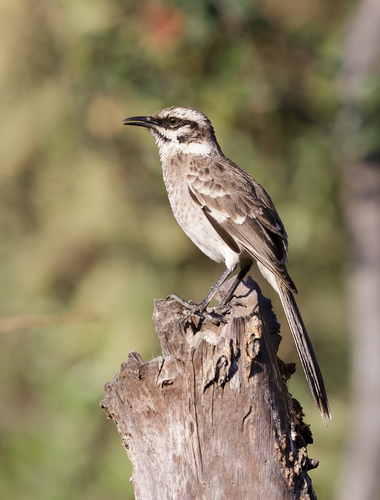
Long-tailed Mockingbird
Mimus longicaudatus
A master mimic with a flair for the dramatic, the Long-tailed Mockingbird is the vocal heart of the South American dry forests and gardens.
Quick Identification
Size
Length 26–30 cm (10.2–11.8 in); weight 50–75 g (1.8–2.6 oz). Notable for its elongated tail.
Colors
Grey-brown upperparts, pale grey to white underparts; dark mask through eyes; white tips on long tail feathers.
Key Features
- Exceptionally long, white-tipped tail
- Distinct dark eye-mask
- White wing bars visible in flight
- Slightly decurved dark bill
When You’ll See Them
Geographic range
Where Does the Long-tailed Mockingbird Live?
The Long-tailed Mockingbird is a native icon of western South America, specifically inhabiting the Tumbesian region. Its core range stretches along the Pacific coast from southern Ecuador down through western Peru. Within these countries, it thrives in the arid lowlands and interior valleys, remaining a permanent resident throughout the year without any migratory movement.
Basemap © OpenStreetMap contributors
Behavior
The Long-tailed Mockingbird is a charismatic and highly vocal resident of the South American dry coast. Like its relatives in the Mimidae family, it is a master mimic, capable of imitating the calls of dozens of other bird species, as well as mechanical sounds. It is frequently seen perched on high, exposed vantage points—such as the tops of tall cacti, utility poles, or rooftops—where it broadcasts its complex, melodic song to defend its territory.
On the ground, these birds are energetic and bold. They move with a characteristic hopping gait, often cocking their long tails upward or flicking them from side to side. While they can be quite territorial toward other mockingbirds, they are generally tolerant of humans and have adapted remarkably well to suburban environments, often becoming a familiar presence in gardens and town parks. Their social structure is typically based on breeding pairs, though they may gather in looser groups where food is abundant.
EverydayEarth exclusive
Camera Tips
To capture the best footage of the Long-tailed Mockingbird, focus your camera placement on elevated 'singing posts.' These birds are creatures of habit and will often return to the exact same branch, fence post, or utility wire every morning to sing. Position your camera at eye-level with these perches, ideally 5 to 7 feet off the ground, and use a narrow-angle setting to frame the bird clearly against the sky or a distant background.
Because they are frequent ground-foragers, a secondary 'action' camera placed near a patch of open soil or leaf litter can capture fascinating behavior. These birds are highly attracted to water in their arid habitat; a shallow birdbath is the single best lure for a backyard camera setup. Place the camera about 2 feet from the water source at a low angle to capture the dramatic splashing and tail-flicking that occurs during their daily baths.
For camera settings, prioritize a fast trigger speed. Long-tailed Mockingbirds are quick and twitchy; a slow camera will often capture only a blur or a disappearing tail. If your camera supports high-frame-rate video (60fps or higher), use it to capture the intricate movements of their tail. Early morning light provides the best illumination for their grey plumage, but ensure the sun is at your back so the AI can correctly identify the facial mask and wing bars without the bird being silhouetted.
Similar Species
Species that look similar or are commonly confused with Long-tailed Mockingbird.
Frequently Asked Questions
Record Long-tailed Mockingbird at your habitat
Connect a camera to start building your own species record — AI identifies every visitor automatically.