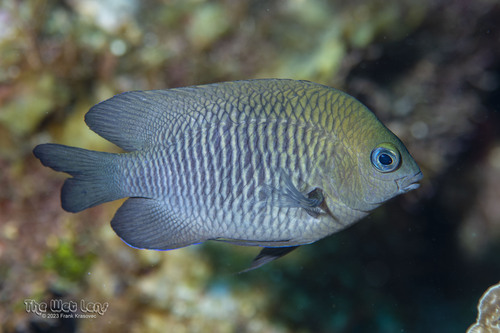
Longfin Damselfish
Stegastes diencaeus
The Longfin Damselfish is the reef's dedicated gardener, famous for cultivating algae lawns and even domesticating its own 'livestock' of shrimp. This feisty Caribbean resident is a master of territorial defense and inter-species cooperation.
Quick Identification
Size
Maximum length of 12.5 cm (4.9 inches)
Colors
Adults are dark grey to brownish-black with a yellowish or golden wash on the face and fins; juveniles are bright yellow with neon blue lines on the head and a black ocellus (eye-spot) on the dorsal fin.
Key Features
- Extremely long and pointed dorsal and anal fins extending past the tail base
- Aggressive territorial behavior over 'algae lawns'
- Dusky dark body with a subtle golden sheen in adults
- Juveniles have iridescent blue markings and a dorsal eyespot
When You’ll See Them
Geographic range
Where Does the Longfin Damselfish Live?
Native to the tropical Western Atlantic, the Longfin Damselfish is a quintessential resident of Caribbean coral ecosystems. Its range extends from the southern coast of Florida and the Bahamas through the entire Caribbean basin, including the Greater and Lesser Antilles. It is also commonly found along the Central and South American coastlines from Mexico down to Venezuela, thriving in clear, warm waters with high reef complexity.
Basemap © OpenStreetMap contributors
Behavior
Longfin Damselfish are the industrious 'farmers' of the coral reef. They are famous for their high levels of territoriality, as they spend most of their lives cultivating and guarding a private patch of filamentous algae. They act as gardeners, actively 'weeding' their territory by removing unpalatable algae species to ensure their preferred food source has room to grow. This territoriality is so intense that they will aggressively charge and nip at much larger fish, and even human divers, who stray too close to their garden.
Perhaps their most fascinating behavior is their mutualistic relationship with mysid shrimp. These fish have been observed 'domesticating' shrimp colonies, allowing the shrimp to live safely within their territory. The shrimp provide the fish with nutrient-rich waste that fertilizes the algae garden, while the damselfish provides the shrimp with a safe haven from predators. They are social primarily in the context of these inter-species relationships and their immediate family during spawning, but are otherwise solitary defenders of their patch.
EverydayEarth exclusive
Camera Tips
To capture high-quality footage of the Longfin Damselfish, you must first identify their 'farm.' Look for patches of the reef that appear unusually green or fuzzy compared to the surrounding area; these are the algae lawns the damselfish meticulously maintains. Once you find a garden, you can be certain the fish is nearby, as they rarely stray more than a meter from their territory. Position your underwater camera on a weighted tripod or a stable rock nearby, aiming the lens at a slight upward angle toward the center of the algae patch.
Lighting is crucial for underwater photography. The best time to capture the golden sheen of the adults or the vibrant blue of the juveniles is between 10 AM and 2 PM, when the sun is directly overhead and pierces the water column with maximum intensity. If your camera setup allows for it, use a red filter to restore the warm tones that are often lost at depth, or ensure you have a strong external strobe or video light to bring out the subtle yellow wash on the fish's face.
Because these fish are highly territorial, they move in quick, darting bursts. Set your camera to a high shutter speed (at least 1/500s for stills) or a high frame rate for video (60fps or higher) to avoid motion blur during their aggressive displays. You can often trigger a 'charge' by placing the camera within the periphery of their territory; the fish will likely approach the lens to inspect or drive off the intruder, providing an excellent close-up shot.
Avoid using bait, as Longfin Damselfish are herbivores and are more motivated by territory than by snacks. Instead, look for a territory that also contains a swarm of mysid shrimp. If you can keep the camera steady enough, you may capture the rare and scientifically significant 'herding' behavior where the damselfish patrols the perimeter of its shrimp colony. Always ensure your camera placement does not crush live coral, and use a tether to prevent the gear from being swept away by tidal surges.
Similar Species
Species that look similar or are commonly confused with Longfin Damselfish.
Frequently Asked Questions
Record Longfin Damselfish at your habitat
Connect a camera to start building your own species record — AI identifies every visitor automatically.