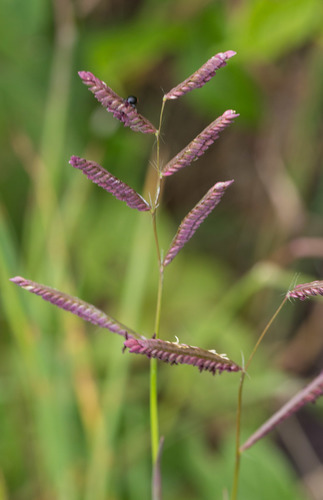
Longtom
Paspalum denticulatum
A resilient specialist of the wetlands, Longtom creates lush, green carpets in the dampest corners of the backyard. This moisture-loving grass is more than just ground cover; it is a bustling hub for the tiny creatures that thrive where water meets land.
Quick Identification
Size
Height of 30–60 cm (12–24 inches); leaf blades 5–20 cm (2–8 inches) long.
Colors
Vibrant lime to deep green foliage; seed heads feature brownish-green spikes with tiny dark purple anthers.
Key Features
- Creeping rhizomatous growth forming dense mats
- Distinctive V-shaped seed heads with 2-3 racemes
- Leaf margins are slightly 'toothed' or fringed near the base
- Prefers wet, boggy soil conditions
When You’ll See Them
Geographic range
Where Does the Longtom Live?
Native to the Australasian and Indo-Pacific regions, Longtom is most commonly found across northern and eastern Australia, particularly in Queensland and New South Wales. Its range extends through Indonesia, the Philippines, and into parts of Southeast Asia, where it thrives in tropical and subtropical climates. While not widely introduced globally, it is a staple of coastal and inland wetlands within its native territory.
Basemap © OpenStreetMap contributors
Behavior
Longtom is a perennial, mat-forming grass that thrives in high-moisture environments. It is known for its resilient growth habit, spreading rapidly via underground rhizomes and surface stolons. This allows it to colonize damp areas of backyards, creek banks, and drainage ditches where other grasses might drown. Unlike upright clump grasses, Longtom creates a thick, springy carpet that is excellent at stabilizing soil against erosion.
In a backyard ecosystem, Longtom acts as a primary producer and a crucial structural component of the habitat. It doesn't 'behave' in the animal sense, but it responds dynamically to environmental cues, flowering prolifically after heavy rains and entering a semi-dormant state during rare dry spells. It is often considered a 'indicator species'—if Longtom is flourishing in your yard, you likely have a high water table or poor drainage.
EverydayEarth exclusive
Camera Tips
When monitoring Longtom with a backyard camera, your primary challenge will be 'false triggers.' Because this grass grows in wet, often windy areas, its long leaf blades can move significantly, causing PIR sensors to record hundreds of empty videos. To avoid this, set your camera to 'High' sensitivity but use a 'Detection Zone' feature to mask out the upper moving blades, focusing the trigger area on the stable ground at the base of the grass.
Longtom is a 'highway' for small wildlife. Place your camera at a very low height—no more than 4-6 inches off the ground—aiming parallel to the edge of a Longtom patch. This allows you to capture the frogs, skinks, and small snakes that use the dense mat as cover. If you are using an AI camera, look for 'Pet' or 'Small Animal' settings, as many species hiding in Longtom are overlooked by standard human-centric AI models.
For a unique perspective, use your camera's time-lapse mode. Set the camera to take one photo every hour during daylight. Over a few weeks, you will see the remarkable speed at which Longtom stolons 'creep' across the soil and how the seed heads emerge and unfurl after a rain event. This is an excellent way to document the changing moisture levels of your backyard ecosystem.
Consider the lighting: Longtom's bright green blades can become overexposed in direct midday sun. Position your camera facing south (in the Southern Hemisphere) to keep the sun behind the lens, ensuring the deep textures and 'toothed' edges of the leaves are visible in your captures. If you are tracking nocturnal visitors like bandicoots or wallabies that graze on the edges, ensure your IR flash is not aimed too closely at the grass, as the reflective blades can 'white out' the foreground.
Frequently Asked Questions
Record Longtom at your habitat
Connect a camera to start building your own species record — AI identifies every visitor automatically.