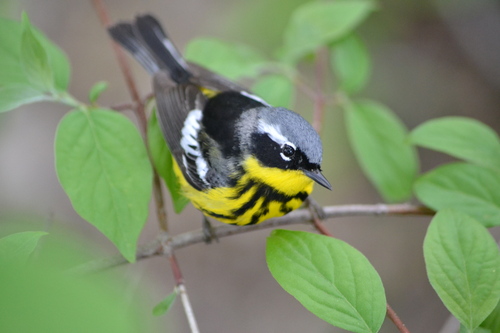
Magnolia Warbler
Setophaga magnolia
A vibrant jewel of the boreal forest, the Magnolia Warbler is famous for its 'necklace' of black streaks and its habit of showing off striking white tail patches.
Quick Identification
Size
Length: 11–13 cm (4.3–5.1 in); Wingspan: 16–20 cm (6.3–7.9 in); Weight: 7–15 g (0.25–0.5 oz)
Colors
Breeding males feature a striking yellow throat and belly with heavy black streaking (the 'necklace'), a gray crown, and a black face mask. Females and immatures are duller with gray-green backs and fainter streaking.
Key Features
- Heavy black streaks forming a 'necklace' on a bright yellow breast
- Large white patches across the middle of the tail feathers
- Bright yellow rump visible during flight
- Distinctive white wing bars and a gray crown
When You’ll See Them
Geographic range
Where Does the Magnolia Warbler Live?
The Magnolia Warbler is a native of North America, breeding across a wide belt of the boreal forest stretching from central Canada and the Great Lakes region through the northeastern United States and the Appalachian Mountains. As a Neotropical migrant, it travels south each autumn to its wintering grounds in Mexico, Central America, and the Caribbean. During its journey, this species is a frequent visitor to backyard gardens and urban parks across the eastern and central United States, making it one of the most widely recognized migrants of the spring and fall seasons.
Basemap © OpenStreetMap contributors
Behavior
Magnolia Warblers are energetic and restless foragers, rarely staying still for more than a few seconds. They are known for a characteristic behavior of drooping their wings and fanning their tails, which prominently displays their large white tail patches. This tail-fanning is thought to startle insects, making them easier to catch as they take flight.
During the breeding season, they are highly territorial and can be found in the lower to middle layers of dense coniferous forests. While they are not particularly bold around humans, their inquisitive nature often brings them within close range of observers during migration, especially when they are foraging in low shrubs or garden edges.
EverydayEarth exclusive
Camera Tips
To capture the Magnolia Warbler on camera, focus on the lower canopy. Unlike many other warblers that stay high in the treetops, Magnolias prefer dense shrubs and the lower branches of young evergreens. Position your camera about 3 to 5 feet off the ground, angled slightly upward toward a favorite perching branch or a cluster of low-hanging leaves where they are likely to glean insects.
Since Magnolia Warblers are insectivores and won't visit traditional seed feeders, water is your best lure. A birdbath with a solar-powered dripper or a small misting system is incredibly effective. These birds are highly attracted to the sound and visual of moving water during their long migratory journeys. Place your camera with a clear line of sight to the water source, ensuring a fast shutter speed to freeze their rapid movements.
Lighting is crucial for bringing out their vibrant yellow and deep black contrast. Early morning light (the 'golden hour') is best, as it illuminates their yellow breast without washing out the delicate gray tones on their head. Avoid placing cameras in deep, mottled shade where the AI might struggle to pick up the movement against a complex background.
During peak migration months (May and September), set your camera to a 'burst' or 'multi-shot' mode. Magnolia Warblers move with a 'flit-and-pause' rhythm; a single photo often catches them mid-blur, but a burst of three to five images is much more likely to yield a stunning, sharp portrait of the bird fanning its tail.
Similar Species
Species that look similar or are commonly confused with Magnolia Warbler.
Canada Warbler
Also has a black 'necklace' on a yellow breast, but lacks the Magnolia's bright yellow rump and white tail patches.
Yellow-rumped Warbler
Shares the yellow rump, but has a white throat and distinct yellow patches on the sides of the breast rather than a full yellow belly.
Prairie Warbler
Has similar yellow underparts and black streaks, but the streaks are on the sides of the body rather than across the chest, and it lacks the white tail band.
Frequently Asked Questions
Record Magnolia Warbler at your habitat
Connect a camera to start building your own species record — AI identifies every visitor automatically.