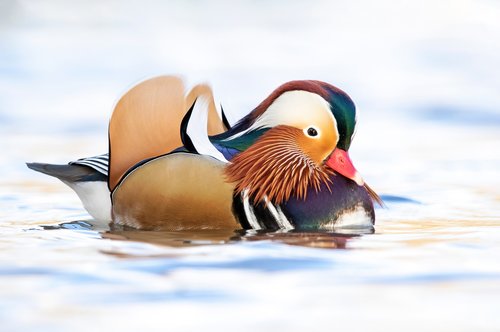
Mandarin Duck
Aix galericulata
A masterpiece of nature, the Mandarin Duck is widely considered the world's most beautiful waterfowl. With its kaleidoscopic feathers and penchant for perching in trees, it brings a touch of exotic elegance to wooded wetlands and quiet backyard ponds.
Quick Identification
Size
Length: 41-49 cm (16-19 in); Wingspan: 65-75 cm (26-30 in); Weight: 428-693 g (0.9-1.5 lbs)
Colors
Males are multi-colored with orange 'sails', a purple breast, and a green/copper crest; females are olive-grey with white eye-rings.
Key Features
- Elaborate orange 'sail' feathers on males
- White eye-ring with a narrow trailing stripe on females
- Bushy crest and neck ruff
- Often seen perching in trees
When You’ll See Them
Geographic range
Where Does the Mandarin Duck Live?
Native to the East Palearctic, the Mandarin Duck is originally found across East Asia, including eastern Russia, China, Korea, and Japan. Due to their popularity in private collections, significant introduced populations have established themselves across the United Kingdom and Western Europe. In the United States, smaller localized populations can be found in coastal regions like California, where they thrive in wooded wetlands similar to their native habitat.
Basemap © OpenStreetMap contributors
Behavior
During the breeding season, they are famous for their strong pair bonds and elaborate courtship displays, which include rhythmic head-shaking and puffing out their magnificent 'sail' feathers. They are cavity nesters, with the female selecting a hole in a tree often several meters above the ground. Despite their shy nature, they can become habituated to human presence in urban parks, though they remain quick to take flight if startled.
EverydayEarth exclusive
Camera Tips
To capture the stunning plumage of a Mandarin Duck, camera placement is everything. These ducks love 'loafing' spots—logs or rocks that break the surface of the water near a bank. Position your camera about 12-18 inches above the ground, aimed at a partially submerged log or a flat, muddy bank that is obscured by overhanging branches. This low angle provides an intimate perspective and often captures the vibrant reflections of the male's colors in the water.
Because they are cavity nesters, you have a unique opportunity during the spring (March to May). If you have large deciduous trees like oaks or maples near water, try mounting a camera 10-15 feet up a trunk facing a natural cavity or a specialized nesting box. If you're lucky, you might record the 'jump,' where day-old ducklings leap from the high nest to the forest floor below.
Use high-speed trigger settings and a multi-photo burst mode. Mandarins are twitchy and fast-moving; a single shot might only catch a blurry wing. A 3-5 shot burst ensures you get a clear frame of the male's sail feathers or the female's delicate eye markings. If your camera has a 'silent shutter' or quiet operation mode, enable it, as these birds are extremely sensitive to mechanical clicks and may avoid the area if they hear the equipment engaging.
In terms of timing, focus your efforts on the golden hours. While the AI will detect them during the day, the soft light of dawn and dusk avoids the harsh glares on the water and brings out the metallic greens and coppers in the male's crest. If you are in a backyard setting, keeping a corner of your pond wild with tall grasses or fallen branches will make them feel secure enough to linger in front of the lens.
Similar Species
Species that look similar or are commonly confused with Mandarin Duck.
Frequently Asked Questions
Record Mandarin Duck at your habitat
Connect a camera to start building your own species record — AI identifies every visitor automatically.