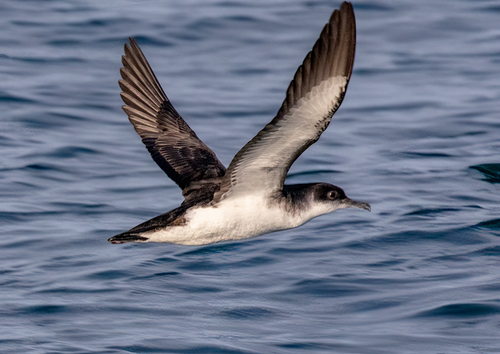
Manx Shearwater
Puffinus puffinus
The ultimate Atlantic voyager, the Manx Shearwater spends its life bridging the gap between the ocean's surface and secret island burrows. Witness the nocturnal life of these incredible marathon migrants.
Quick Identification
Size
Length: 30-38 cm (12-15 in); Wingspan: 76-89 cm (30-35 in); Weight: 350-450 g (12-16 oz)
Colors
Contrast of soot-black upperparts and bright white underparts; dark gray bill and pinkish-gray legs
Key Features
- Sharp contrast between black back and white belly
- Long, narrow wings held stiffly during flight
- Deeply hooked dark bill
- Nests in underground burrows
- Shuffling, belly-sliding movement on land
When You’ll See Them
Geographic range
Where Does the Manx Shearwater Live?
The Manx Shearwater is a native of the North Atlantic, with its primary breeding strongholds located on the rugged islands of the United Kingdom, Ireland, and Iceland. During the northern summer, they can be found across the maritime regions of Western Europe and the eastern coast of Canada. As autumn approaches, they undertake a staggering 10,000-kilometer migration across the equator to winter off the coasts of South America, particularly Brazil and Argentina, making them one of the most well-traveled species in the Atlantic basin.
Basemap © OpenStreetMap contributors
Behavior
Manx Shearwaters are masters of the air and sea, known for their incredible "shearing" flight where they tilt from side to side, barely skimming the wave tops with their wingtips. They are highly gregarious at sea, often forming large groups called 'rafts' just offshore before darkness falls. Because they are vulnerable to predators like Great Black-backed Gulls, they have evolved a strictly nocturnal schedule when visiting land, arriving at their breeding colonies only under the cover of pitch darkness.
On land, they are remarkably clumsy due to their legs being positioned far back on their bodies—an adaptation that makes them elite swimmers but poor walkers. They communicate with haunting, rhythmic, and guttural cackling calls that can make a nesting colony sound quite supernatural at night. Despite their awkwardness on terra firma, they are one of the longest-lived bird species, with some individuals recorded reaching over 50 years of age.
EverydayEarth exclusive
Camera Tips
Capturing a Manx Shearwater on camera requires a specialized approach because you won't find them in a typical suburban backyard. If you live near a coastal cliff or a known island colony, place your camera within a few feet of a burrow entrance. These burrows are usually located in soft, grassy turf or among rocky scree. Set your camera low—about 6 to 12 inches off the ground—to capture their unique shuffling gait as they enter and exit their underground homes.
Night vision is the most critical feature for this species. Since they are strictly nocturnal on land, you need a camera with high-quality infrared (IR) LEDs that won't startle the birds but will provide crisp black-and-white imagery in total darkness. Use a high-sensitivity trigger setting, as these birds can move surprisingly quickly when they scramble from the air into the safety of their burrows to avoid predators.
Video mode is highly recommended over still photos to capture their vocalizations and social interactions. If you are monitoring a colony, the peak activity occurs during the darkest hours of the night, especially on overcast nights when there is little moonshine to guide predators. Ensure your camera is well-secured against high coastal winds and salt spray, using a protective housing if necessary.
Similar Species
Species that look similar or are commonly confused with Manx Shearwater.
Balearic Shearwater
Brownish-grey underparts rather than pure white, and a more 'dirty' appearance on the flanks.
Atlantic Puffin
Much shorter wings, a rounder body, and a distinctive colorful, parrot-like beak.
Sooty Shearwater
Larger and almost entirely dark brown/black without the clean white belly of the Manx.
Frequently Asked Questions
Record Manx Shearwater at your habitat
Connect a camera to start building your own species record — AI identifies every visitor automatically.