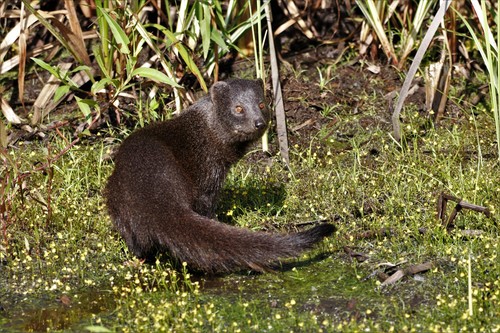
Marsh Mongoose
Atilax paludinosus
Master of the African riverbanks, the Marsh Mongoose is a secretive, shaggy-haired specialist that hunts by touch in the murky depths of wetlands.
Quick Identification
Size
Total length 80–100 cm (31–39 in); Weight 2.5–4.5 kg (5.5–10 lbs)
Colors
Uniform dark chocolate brown to nearly black fur; shaggy guard hairs; skin on the nose and paws is typically dark.
Key Features
- Large, robust build with a thick, bushy tail
- Highly sensitive, unwebbed forepaws for tactile foraging
- Shaggy, water-resistant dark brown fur
- Distinctive humped gait when moving on land
When You’ll See Them
Geographic range
Where Does the Marsh Mongoose Live?
The Marsh Mongoose is widely distributed across sub-Saharan Africa, thriving in almost every country from Senegal in the west to Ethiopia in the east, and stretching all the way down to the southern tip of South Africa. It is a true specialist of the African waterways, found wherever permanent freshwater and thick cover coexist, though it is notably absent from the arid Sahara and the driest parts of the Namib and Kalahari deserts.
Basemap © OpenStreetMap contributors
Recorded on EverydayEarth
Behavior
The Marsh Mongoose is a solitary and highly specialized carnivore that has carved out a niche as the premier aquatic predator of the mongoose family. Unlike its social cousins, this species is a lone wanderer of the water’s edge, possessing a high level of intelligence and a unique hunting style. They are famous for their tactile sensitivity; they use their dexterous, unwebbed front paws to feel under rocks and in the mud for hidden prey, much like a raccoon.
These animals are extremely resourceful and are known to use 'anvils'—hard rocks or surfaces—to break open the shells of crabs and large snails. While they are primarily active during the twilight hours of dawn and dusk, they are occasionally seen during the day in quiet, undisturbed areas. They are excellent swimmers but prefer to hunt in shallow water where they can remain in contact with the ground.
EverydayEarth exclusive
Camera Tips
To capture the Marsh Mongoose on camera, you must focus on 'corridors.' These animals are creatures of habit and will follow the same muddy paths along a riverbank or through a reed bed for weeks. Look for flattened vegetation or distinctive five-toed tracks in the mud that lack webbing. Position your camera low to the ground—about 20-30 centimeters high—and aim it across a known path rather than directly down it to get a clear side profile of their long, shaggy bodies.
Because they are primarily crepuscular (dawn and dusk) and nocturnal, a camera with a high-quality No-Glow infrared flash is essential. Standard white flashes or even Low-Glow LEDs can sometimes startle them, causing them to bolt before you get a good shot. If you are setting up in a backyard with a pond, placing the camera near a flat 'cracking stone'—a rock where you see broken snail or crab shells—is the most reliable way to ensure a visit.
If you want them to linger, use a scent lure rather than a large pile of food which might attract unwanted scavengers. A small sponge soaked in fish oil or a tiny bit of tinned sardines hidden inside a perforated PVC pipe or container will keep them sniffing around the area for several minutes. This provides a much better opportunity for video recording. Given their aquatic habitat, always ensure your camera housing is well-sealed against humidity, and consider using a rain shield to keep the lens clear during the misty morning hours when they are most active.
Frequently Asked Questions
Record Marsh Mongoose at your habitat
Connect a camera to start building your own species record — AI identifies every visitor automatically.