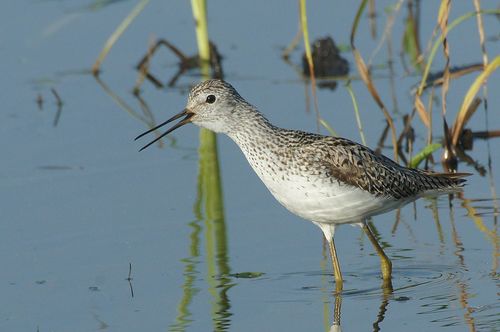
Marsh Sandpiper
Tringa stagnatilis
An elegant, long-legged traveler of the world's wetlands, the Marsh Sandpiper stands out with its needle-thin bill and graceful gait. This refined wader is a favorite for those who love the subtle beauty of migratory shorebirds.
Quick Identification
Size
Length 22–25 cm (8.7–9.8 in); Wingspan 55–59 cm (21.7–23.2 in); Weight 55–120 g (1.9–4.2 oz)
Colors
Pale grey-brown upperparts with dark spotting in breeding season; uniform pale grey in winter; white underparts; greenish-yellow legs
Key Features
- Extremely fine, needle-like black bill
- Long, spindly greenish-yellow legs that trail far behind the tail in flight
- Pure white wedge on the lower back and rump
- Ethereal, slender 'miniature Greenshank' silhouette
When You’ll See Them
Geographic range
Where Does the Marsh Sandpiper Live?
The Marsh Sandpiper is a wide-ranging migratory species that breeds across the temperate grasslands and taiga wetlands of Eastern Europe, Central Asia, and the Russian Far East. As a true global traveler, it spends the northern winter in sub-Saharan Africa, the Indian subcontinent, Southeast Asia, and throughout Australia. While it is primarily a bird of the Eastern Hemisphere, it is frequently sighted in coastal and inland wetlands across dozens of countries during its biannual migrations.
Basemap © OpenStreetMap contributors
Behavior
The Marsh Sandpiper is celebrated for its graceful and delicate demeanor. Unlike some of its more boisterous relatives, this species moves with a refined, light-footed gait across soft mud and through shallow water. They are highly active foragers, often seen walking at a steady pace while picking prey from the water's surface or probing gently into the substrate. While they can be found in small, dedicated groups, they are also quite social and frequently join mixed-species flocks of other shanks and stints during their long migratory journeys.
Their flight is swift and direct, often accompanied by a distinctive, thin 'teu' call that helps birdwatchers identify them before they even land. In their breeding grounds, males perform impressive aerial displays to defend territories, but for most of the year, they are relatively quiet and unassuming visitors to wetlands. They are generally wary of humans, though they can become accustomed to observers if approached slowly or viewed from a distance through a lens.
EverydayEarth exclusive
Camera Tips
To successfully capture a Marsh Sandpiper on a backyard or trail camera, placement is critical. These birds are 'edge' specialists, so your camera should be positioned mere inches above the mudline or water level at the edge of a pond, marsh, or flooded area. A low-angle shot not only captures their characteristic long-legged silhouette but also provides a more intimate perspective on their delicate facial features and needle-thin bill. Use a waterproof housing or a mount that can be securely anchored in soft ground.
Because Marsh Sandpipers are most active during the 'golden hours' of early morning and late afternoon, choose a camera with a high-quality sensor that performs well in low-light conditions. Since they are constantly on the move while foraging, set your camera to a fast trigger speed and utilize a multi-shot burst mode. This ensures you catch the quick pecking actions or the moment they take flight, which is the best time to see the diagnostic white wedge on their back.
If you have a large property with a wetland area, you can encourage them to visit your camera's field of view by maintaining a clear, muddy shoreline. They avoid tall, thick vegetation where predators might hide, so a clear 'landing strip' of mud or very shallow water (less than 2 inches deep) is the best lure. Avoid using artificial food; instead, focus on providing a healthy, pesticide-free aquatic environment that supports the larvae and small insects they naturally crave.
Similar Species
Species that look similar or are commonly confused with Marsh Sandpiper.
Common Greenshank
Larger and stockier with a thicker, slightly up-curved bill compared to the Marsh Sandpiper's needle-straight bill.
Wood Sandpiper
Has more heavily spotted brown upperparts, a prominent pale eyebrow (supercilium), and shorter legs.
Wilson's Phalarope
While similarly slender, phalaropes often swim in circles to create eddies, a behavior Marsh Sandpipers never exhibit.
Frequently Asked Questions
Record Marsh Sandpiper at your habitat
Connect a camera to start building your own species record — AI identifies every visitor automatically.