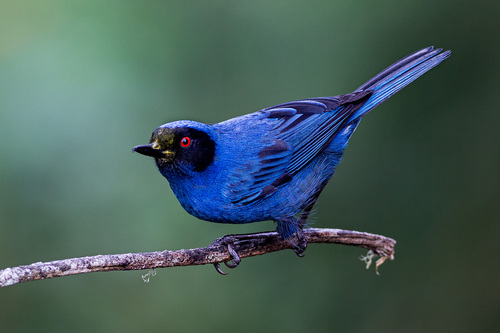
Masked Flowerpiercer
Diglossa cyanea
With its striking ultramarine plumage and piercing red eyes, the Masked Flowerpiercer is a jewel of the Andean cloud forest. Known for its clever 'nectar-robbing' technique, this vibrant bird is a favorite for backyard observers in South America’s mountain regions.
Quick Identification
Size
Length: 14.5–15.5 cm (5.7–6.1 in); Weight: 18–25 g (0.6–0.9 oz)
Colors
Deep ultramarine blue body with a contrasting jet-black mask; eyes are a striking bright red or orange-red.
Key Features
- Distinctive hooked tip on the upper mandible
- Jet-black mask extending across the forehead and through the eyes
- Vibrant red iris contrasting with blue plumage
- Stocky, short-tailed silhouette compared to other tanagers
When You’ll See Them
Geographic range
Where Does the Masked Flowerpiercer Live?
Native to the South American continent, the Masked Flowerpiercer is a quintessential bird of the tropical Andes. Its core range follows the mountain chain through Venezuela, Colombia, Ecuador, Peru, and into western Bolivia. It is a high-altitude specialist, rarely descending into the lowlands, and is a familiar sight in mountain towns and misty cloud forests across these five nations.
Basemap © OpenStreetMap contributors
Behavior
The Masked Flowerpiercer is an energetic and bold resident of high-altitude environments. It is famously known as a "nectar robber." Unlike hummingbirds that pollinate flowers by reaching into the bloom, the flowerpiercer uses its specialized hooked bill to pierce a hole in the base of the flower's corolla. This allows it to steal the nectar without ever coming into contact with the plant's pollen. This resourceful behavior makes them highly efficient foragers in the competitive cloud forest ecosystem.
These birds are quite territorial, particularly around rich nectar sources like flowering bushes or garden feeders. They are often seen flitting rapidly between perches, letting out high-pitched chips as they move. While they are usually seen alone or in pairs, they frequently join mixed-species foraging flocks, moving through the canopy alongside other tanagers and warblers. Despite their small size, their bright blue color and active nature make them one of the more conspicuous birds in their habitat.
EverydayEarth exclusive
Camera Tips
To capture the best footage of a Masked Flowerpiercer, focus your camera on nectar sources. Because they don't hover, they require a stable perch to feed. Look for tubular flowers like Fuchsias or Salvias and position your camera at a distance of 2 to 4 feet, aimed at a branch that provides the bird easy access to the flower bases. A side-on angle is best for showcasing their unique hooked bill in action as they pierce the blooms.
If you are using a backyard bird feeder, these birds are very attracted to sugar-water stations. Mount your camera at eye level with the feeder perches. Because their blue plumage can appear very dark in shadows, try to place your setup in an area that receives bright, indirect morning light. Direct, harsh sunlight at high altitudes can cause glare, but early morning light will make their ultramarine feathers and red eyes pop.
Set your camera to a high trigger sensitivity and a short burst mode or high-definition video. These birds move with quick, jerky motions and rarely stay in one spot for long. If your camera allows for macro settings, use them—Masked Flowerpiercers are small, and getting a clear shot of the black mask and red eye requires a sharp focus. During the misty afternoons common in their range, ensure your camera lens is treated with an anti-fog coating to prevent condensation from ruining the shot.
Similar Species
Species that look similar or are commonly confused with Masked Flowerpiercer.
Frequently Asked Questions
Record Masked Flowerpiercer at your habitat
Connect a camera to start building your own species record — AI identifies every visitor automatically.