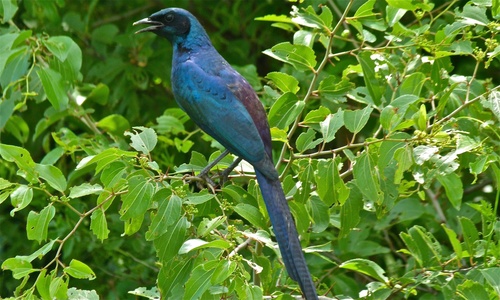
Meves's Starling
Lamprotornis mevesii
A masterpiece of iridescence and elegance, Meves's Starling is famous for its shimmering purple-blue plumage and exceptionally long, graduated tail.
Quick Identification
Size
30-34 cm (12-13.5 in) in length; weighs between 56-115g (2-4 oz)
Colors
Highly iridescent blue-green body; tail and rump appear bronze-purple; dark facial mask with a pale creamy-white or yellow eye
Key Features
- Extraordinarily long, graduated tail
- Shimmering metallic blue-green and purple plumage
- Dark mask extending through the eye
- Robust, black bill with a slight hook
When You’ll See Them
Geographic range
Where Does the Meves's Starling Live?
Meves's Starling is native to the subtropical and tropical regions of Southern Africa. Its core range spans across northern Botswana, Zimbabwe, and central Mozambique, extending northward into southern Angola, Zambia, and Malawi. It is also a prominent resident in the northern reaches of Namibia and the Limpopo River valley in South Africa, where it thrives in woodlands that provide both nesting cavities and proximity to water.
Basemap © OpenStreetMap contributors
Behavior
Meves's Starling is a highly social and vocal bird, often found in small family groups or larger flocks of up to ten individuals. They are frequently observed foraging on the ground, using a combination of graceful hops and brisk walks to navigate through leaf litter. Unlike some of their more skittish relatives, these starlings can become quite habituated to human presence, especially around lodges and campsites where they may investigate outdoor dining areas for scraps.
These birds are known for their complex vocalizations, which include a variety of harsh squeaks, whistles, and chattering notes. During the breeding season, they are cavity nesters, often utilizing natural hollows in trees like the Mopane or Baobab. They are non-migratory, maintaining a year-round presence in their preferred territories, though they may wander locally in search of water during particularly dry spells.
EverydayEarth exclusive
Camera Tips
To capture the stunning iridescence of Meves's Starling, camera placement is critical. These birds spend a significant amount of time foraging on the ground, so mounting your AI-powered camera at a low height—roughly 12 to 18 inches—is ideal. Aim the lens toward an open patch of soil or short grass, preferably near Mopane trees or riverine thickets. Because their feathers reflect light differently depending on the angle, try to position the camera with the sun behind it to maximize the 'glossy' effect on their plumage during the golden hours of early morning or late afternoon.
Water is the ultimate draw for this species, especially in the more arid parts of their range. A shallow bird bath or a dripping water feature will draw them in consistently for bathing and drinking. They are social birds, so if you capture one on camera, you are likely to see several more follow. Use a 'Fast' trigger speed or 'Burst' mode on your camera settings, as these starlings are jittery and prone to sudden, jerky movements that can cause motion blur on slower devices.
If you're using a trail camera in a wilder setting, look for large trees with visible hollows, as these are preferred nesting sites. Focusing your camera on these cavities during the summer breeding season can provide intimate glimpses of their family life. In backyard settings, offering a mix of suet and fresh fruit like chopped apples or grapes can encourage them to linger long enough for high-quality, clear captures.
Similar Species
Species that look similar or are commonly confused with Meves's Starling.
Frequently Asked Questions
Record Meves's Starling at your habitat
Connect a camera to start building your own species record — AI identifies every visitor automatically.