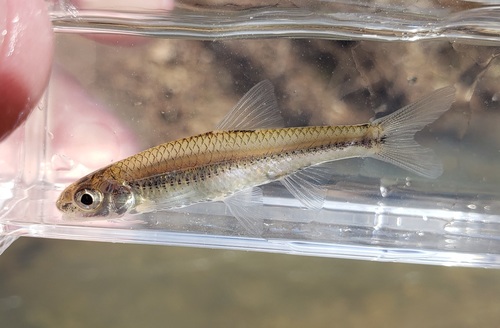
Mimic Shiner
Paranotropis volucellus
A master of camouflage and social schooling, the Mimic Shiner is a shimmering jewel of North American freshwater systems. Though often mistaken for its cousins, this resilient minnow plays a vital role in the health of our rivers and lakes.
Quick Identification
Size
4.5 to 9 cm (1.8 to 3.5 inches) in length; weighs less than 10 grams (0.35 oz)
Colors
Silvery-straw to translucent body with a dark, thin lateral stripe and dusky-edged scales on the upper half
Key Features
- Complete lateral line ending in small dark dots
- Slender, compressed body shape
- Eight dorsal fin rays and a large eye relative to head size
When You’ll See Them
Geographic range
Where Does the Mimic Shiner Live?
The Mimic Shiner is a wide-ranging North American native found throughout the Hudson Bay and Great Lakes drainages, extending across the vast Mississippi River basin. Its territory stretches from the northern waters of Canada down to the Gulf of Mexico, including river systems in Texas and Alabama. While primarily a central and eastern species, established populations also exist in Atlantic Coast drainages, such as the Housatonic River in Connecticut.
Basemap © OpenStreetMap contributors
Behavior
Mimic Shiners are highly social, schooling fish that are often found intermingling with other shiner species. This behavior, known as 'mimicry,' serves as a survival strategy, as blending into larger schools of similar-looking fish reduces the individual's chance of being targeted by predators like Smallmouth Bass or Yellow Perch. They are generally peaceful and spend their days navigating the mid-water to bottom layers of their habitat.
These fish are sensitive to water quality and are often among the first to disappear from an ecosystem if turbidity or pollution levels rise significantly. During the summer months, they engage in broadcast spawning over sandy or gravelly substrates, where their eggs are left to drift and settle into the crevices of the river or lake bed. They do not provide parental care, relying instead on high egg production to ensure the next generation.
EverydayEarth exclusive
Camera Tips
Capturing the Mimic Shiner on camera requires an underwater setup, such as a GoPro or a specialized aquatic trail cam. To get the best results, place your camera in shallow, clear water near the edge of a sandbar or a submerged rock pile. These fish prefer areas with a slight current but will congregate in still 'eddies' to save energy while feeding. Use a weighted tripod or a sand-anchor to ensure the camera remains steady against the flow of water.
Lighting is the most critical factor for fish photography. Position your camera so the sun is behind it or directly overhead; this will illuminate the silvery scales of the shiner and highlight the translucent quality of its fins. If you are recording in a backyard stream, try to clear away floating debris that might trigger the motion sensor unnecessarily, focusing the 'detection zone' on the middle of the water column where schools typically pass through.
While we don't recommend traditional bait which can foul the water, you can naturally attract Mimic Shiners by gently disturbing the upstream substrate (sand or gravel) just before you start recording. This releases tiny larvae and nutrients into the current, mimicking a natural feeding opportunity that will draw the school right in front of your lens. High frame rate settings (60 FPS or 120 FPS) are ideal for capturing their quick, darting movements and social interactions within the school.
Similar Species
Species that look similar or are commonly confused with Mimic Shiner.
Frequently Asked Questions
Record Mimic Shiner at your habitat
Connect a camera to start building your own species record — AI identifies every visitor automatically.