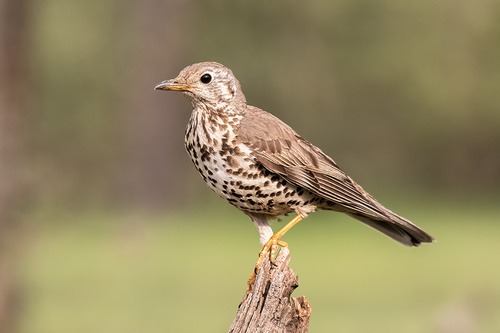
Mistle Thrush
Turdus viscivorus
Meet the 'Stormcock' of the bird world, a bold and hardy thrush that sings in the face of the wind. With its striking spotted plumage and fearless attitude, the Mistle Thrush is a magnificent guardian of the winter garden.
Quick Identification
Size
Length: 27–29 cm (10.6–11.4 in); Wingspan: 42–48 cm (16.5–19 in); Weight: 93–167 g (3.3–5.9 oz)
Colors
Pale grey-brown upperparts and creamy-white underparts with heavy, round black spots. Sexes are identical with white underwing linings that flash in flight.
Key Features
- Large, upright and commanding posture
- Bold, circular black spots on the chest and belly
- White underwing coverts visible during flight
- Greyish-white throat and chin
When You’ll See Them
Geographic range
Where Does the Mistle Thrush Live?
The Mistle Thrush is a widespread species native to the temperate regions of Europe, North Africa, and much of Western and Central Asia. Its core range spans from the British Isles and Scandinavia through Russia to the foothills of the Himalayas. While populations in Western Europe are largely year-round residents, those in the colder northern and eastern regions migrate south to the Mediterranean basin and Southwest Asia for the winter.
Basemap © OpenStreetMap contributors
Behavior
The Mistle Thrush is a bold and aggressive bird, often seen standing tall on open ground or perched at the very top of a tall tree. Unlike its smaller relatives, it is famously territorial, particularly during the winter months when it will vigorously defend a single berry-bearing tree or bush from other thrushes and even larger birds. This 'guarding' behavior ensures a steady food supply throughout the colder months.
Known historically as the 'Stormcock,' the male is celebrated for its habit of singing loudly from high branches during wet and windy weather when most other birds are silent. While they are often solitary or found in pairs, they may form small, loose flocks during the post-breeding season and migration. They are wary birds but have adapted well to human-modified landscapes like large gardens and urban parks.
EverydayEarth exclusive
Camera Tips
To capture high-quality footage of a Mistle Thrush, your best strategy is to focus on their winter food sources. If you have a holly bush, mountain ash, or yew tree in your yard, mount your camera at eye-level with the berries. These birds are famous for 'guarding' a specific bush for weeks at a time, providing frequent opportunities for the camera to trigger as they chase off intruders or return to feed. Use a medium-range focal distance, as they can be flighty and may not approach cameras placed too close to their favorite perching spots.
During the breeding season, ground-level placement is more effective. Set your AI-powered camera near the edge of a lawn or a patch of short grass, especially after rain. Mistle Thrushes forage for worms and invertebrates using a 'run and pause' technique, often standing very upright to scan for danger. A low angle (about 12-18 inches off the ground) will emphasize their impressive size and the bold spotting on their chest. Make sure the camera is positioned to avoid long grass, which can cause false triggers in the wind.
Because they are active early in the morning and often sing during overcast, stormy weather, ensure your camera's low-light settings are optimized. A faster shutter speed is recommended if your camera allows it, as their movements while foraging are quick and jerky. If you are using bait to attract them to a specific spot, fallen apples or berry-mix suet pellets placed in an open area can be very effective during hard frosts when the ground is too frozen for them to dig for worms.
Similar Species
Species that look similar or are commonly confused with Mistle Thrush.
Frequently Asked Questions
Record Mistle Thrush at your habitat
Connect a camera to start building your own species record — AI identifies every visitor automatically.