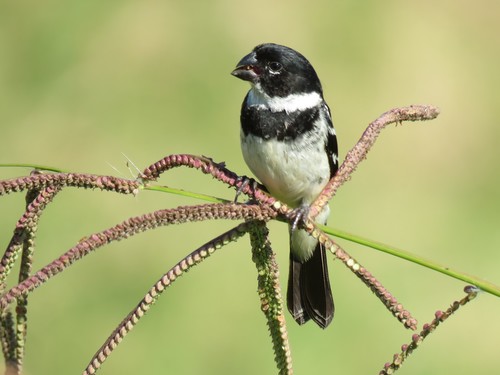
Morelet's Seedeater
Sporophila morelleti
A dapper little bird with a tuxedo-like appearance, Morelet's Seedeater is a cheerful resident of grassy meadows and backyard edges. Once known as the White-collared Seedeater, this vocal songbird brings a touch of tropical charm to the Rio Grande Valley and Central America.
Quick Identification
Size
Length: 10–11 cm (4 in); Wingspan: 15–18 cm (6–7 in); Weight: 8–11 g (0.28–0.39 oz)
Colors
Males feature a black hood, white collar, and black breast band with white underparts; females are sandy-brown or buff with two pale wing bars.
Key Features
- Stubby, thick-based conical bill
- Male has a prominent white collar and black chest band
- Two distinct white wing bars on dark wings
- Constant tail-flicking behavior while perched
When You’ll See Them
Geographic range
Where Does the Morelet's Seedeater Live?
Morelet's Seedeater is native to the Americas, with a range that begins in the southernmost tip of the United States in the Rio Grande Valley of Texas. From there, its territory extends southward through the lowlands of Mexico and throughout Central America, reaching as far as western Panama. It is a highly adaptable species found predominantly in the Caribbean and Gulf slope regions, where it thrives in both rural agricultural lands and developing suburban environments.
Basemap © OpenStreetMap contributors
Behavior
Morelet's Seedeaters are social and energetic passerines, often seen in small groups or mixed-species flocks with other grassquits and seedeaters. They spend the majority of their day foraging in tall grasses, where they exhibit impressive agility by clinging to slender stalks to reach seed heads. Their flight is noticeably bouncy and undulating, and they are frequently seen moving between low shrubs and open grassy patches.
In residential areas, they have become quite accustomed to human activity, often utilizing backyard feeders or overgrown garden edges. During the breeding season, males become highly visible as they choose conspicuous perches—such as fence lines or the tops of tall weeds—to deliver their sweet, warbling song. They are not particularly shy, making them an excellent subject for backyard observation if the right habitat is provided.
EverydayEarth exclusive
Camera Tips
To successfully capture Morelet's Seedeater on an AI-powered camera, you must focus on 'micro-habitats.' These birds are specialists of the tall grass, so positioning your camera at a low height—roughly 1 to 2 feet off the ground—is essential. Aim the lens at a patch of seeding native grasses or a localized cluster of weeds like dandelions or thistles, which act as natural magnets for these small granivores.
If you prefer using a feeder setup, opt for a platform or tray feeder placed near cover. Fill it with white proso millet or a 'finch mix' containing small nyjer seeds. Because these birds are small and move with quick, twitchy motions, set your camera to its highest trigger sensitivity and use a fast shutter speed to prevent motion blur. If your camera allows for focal adjustment, set it for close-range subjects (3-5 feet) to capture the intricate details of the male's tuxedo-like plumage.
Water is an underrated lure for this species. A shallow, ground-level birdbath with a small dripper or solar fountain will attract Morelet's Seedeaters for both drinking and bathing, especially during the drier months. Position your camera on the edge of the water feature, facing north if possible, to ensure even lighting throughout the day without the harsh glare of the sun hitting the lens directly.
Similar Species
Species that look similar or are commonly confused with Morelet's Seedeater.
Frequently Asked Questions
Record Morelet's Seedeater at your habitat
Connect a camera to start building your own species record — AI identifies every visitor automatically.