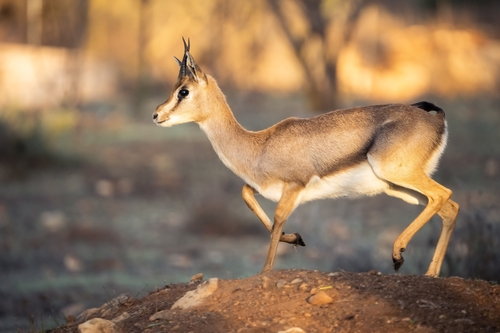
Mountain Gazelle
Gazella gazella
An icon of the Levantine landscape, the Mountain Gazelle is a master of speed and agility, thriving across rugged hills and desert valleys.
Quick Identification
Size
Body length of 100–115 cm (39–45 in); weight ranges from 15–30 kg (33–66 lb)
Colors
Fawn to dark brown upper body with a crisp white underbelly, separated by a dark lateral stripe; white facial stripes running from the eyes toward the snout.
Key Features
- Distinctive S-shaped horns present in both sexes (larger in males)
- Dark brown or black stripe along the flank
- White facial markings and underbelly
- Slender build with long, elegant legs
When You’ll See Them
Geographic range
Where Does the Mountain Gazelle Live?
The Mountain Gazelle is a signature species of the Middle East, primarily concentrated in Israel, which holds the most significant remaining populations. Its range extends into parts of the Palestinian territories, Jordan, and the Arabian Peninsula, including fragmented populations in Saudi Arabia, Oman, and the United Arab Emirates. These adaptable mammals are found across a diverse landscape, from the humid Mediterranean hills to the arid fringes of the desert, and even within the coastal plains where urban expansion meets the wild.
Basemap © OpenStreetMap contributors
Behavior
Mountain Gazelles are highly social yet territorial animals. During the mating season, adult males establish and fiercely defend territories, while females and young roam in small herds of three to eight individuals. They are famously skittish, relying on their incredible speed—reaching up to 80 km/h (50 mph)—and a distinctive bounding leap known as 'stotting' to evade predators like leopards and wolves.
These gazelles are primarily crepuscular, meaning they are most active during the cooler hours of dawn and dusk. In areas where they live close to human settlements, they have become somewhat accustomed to people, often grazing in suburban gardens or agricultural fields on the outskirts of towns, though they remain wary and will flee at any sudden movement.
EverydayEarth exclusive
Camera Tips
To capture high-quality footage of the Mountain Gazelle, placement is everything. These animals follow established trails between their bedding areas in the hills and their feeding grounds in the valleys. Look for 'middens'—communal dung heaps—which males use to mark their territory. Placing your camera 3-5 meters away from a midden at a height of about 60 cm (knee height) will almost guarantee a clear profile shot as the male pauses to investigate the site.
Because Mountain Gazelles are most active during the 'golden hours' of dawn and dusk, ensure your AI camera has strong low-light performance or a high-quality infrared flash. Avoid placing cameras facing directly east or west to prevent the rising or setting sun from blowing out the image. If you are in a particularly arid region, a camera placed near a water source or a lone Acacia tree with low-hanging seed pods will act as a natural magnet for these gazelles.
Settings-wise, use a fast trigger speed (0.3 seconds or less) to catch them as they move quickly through the frame. Since they often travel in small groups, a 'burst mode' of 3-5 photos or a 15-second video clip is better than a single shot, as it allows you to see the social interactions between the mother and her fawn or a territorial male chasing off a rival. If using a backyard camera, place it near the perimeter of your property where the wild vegetation meets the lawn, as they prefer to graze at the 'edge' where they have a quick escape route.
Similar Species
Species that look similar or are commonly confused with Mountain Gazelle.
Frequently Asked Questions
Record Mountain Gazelle at your habitat
Connect a camera to start building your own species record — AI identifies every visitor automatically.