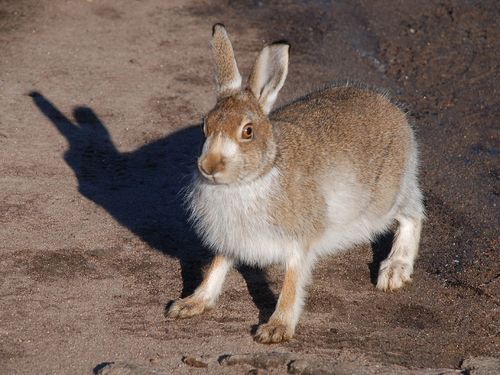
Mountain Hare
Lepus timidus
The ultimate survivor of the high peaks, the Mountain Hare is a shapeshifter that swaps its earthy summer browns for a ghost-white winter coat.
Quick Identification
Size
Length 45–65 cm (18–26 in); Weight 2–5.3 kg (4.4–11.7 lb)
Colors
Brownish-grey in summer; most populations turn pure white in winter, though ear tips remain black year-round.
Key Features
- Ears shorter than the Brown Hare with prominent black tips
- Thick white winter pelage (except in Ireland)
- Large, broad hind paws that act as snowshoes
- Compact, rounded body shape compared to other hares
When You’ll See Them
Geographic range
Where Does the Mountain Hare Live?
Native to the Palearctic region, the Mountain Hare thrives across a vast expanse stretching from Fennoscandia and the Alps across Russia to Eastern Siberia. In the British Isles, they are a iconic sight in the Scottish Highlands and the Peak District, while the unique Irish Hare subspecies is found throughout Ireland. While their core range remains in the northern latitudes of Europe and Asia, they have also been successfully introduced to several islands, including the Faroe Islands and parts of the Svalbard archipelago.
Basemap © OpenStreetMap contributors
Behavior
Mountain Hares are masters of seasonal adaptation, most famous for their remarkable twice-yearly molt. During the day, they typically remain tucked into 'forms'—shallow depressions in the ground, heather, or snow—where they rely on their camouflaged coats to remain invisible to predators like Golden Eagles and Red Foxes. They are primarily crepuscular and nocturnal, emerging as light fades to forage and socialise.
Unlike many other mammals, they are largely solitary but can be seen congregating in small groups in the spring during the breeding season. During this time, they engage in 'boxing' matches, which are actually females fending off over-eager males. They are exceptionally fast runners, capable of reaching speeds of 64 km/h (40 mph) and using zig-zagging maneuvers to escape threats in open terrain.
EverydayEarth exclusive
Camera Tips
To capture the Mountain Hare, position your camera low to the ground, ideally 30 to 50 centimeters (12-20 inches) high. This height mimics their natural eye level and ensures the motion sensor is triggered by their movement. Focus on 'hare runs'—narrow, well-worn paths through heather or grass—or gaps in stone walls where they are known to pass through frequently.
Because they are most active in the twilight and night, a camera with a high-quality 'No-Glow' infrared flash is essential. Standard white flashes can startle these wary animals, causing them to bolt and potentially abandon the area. If you are tracking them in winter, place your camera near stands of willow or gorse, as these are primary food sources when snow covers the ground.
In snowy environments, be mindful of your camera's exposure settings. The bright white landscape can often trick the sensor into underexposing the subject, leaving your hare looking like a dark silhouette. If your camera allows for it, increase the exposure compensation. Lastly, since Mountain Hares are known to frequent the same 'forms' for resting, look for flattened patches of vegetation and set up your camera nearby to capture them as they wake and begin their nightly forage.
Similar Species
Species that look similar or are commonly confused with Mountain Hare.
Frequently Asked Questions
Record Mountain Hare at your habitat
Connect a camera to start building your own species record — AI identifies every visitor automatically.