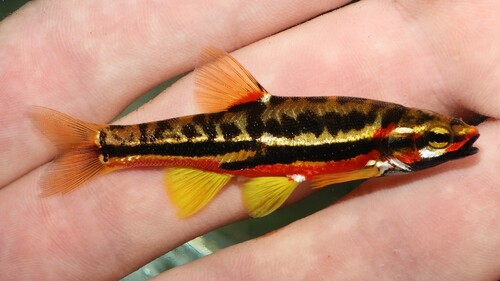
Mountain Redbelly Dace
Chrosomus oreas
A hidden gem of Eastern mountain streams, the Mountain Redbelly Dace is a master of color and community, turning rocky creeks into vibrant underwater galleries each spring.
Quick Identification
Size
5 to 7.5 cm (2 to 3 inches) in length; weighs less than 10 grams
Colors
Dusky olive back with two prominent black lateral stripes; breeding males develop brilliant crimson bellies and yellow-tinted fins
Key Features
- Two parallel black stripes along the sides
- Bright red belly in males during spring
- Small, fine scales with a smooth texture
- Pointed snout with a small terminal mouth
When You’ll See Them
Geographic range
Where Does the Mountain Redbelly Dace Live?
Native to the North American Atlantic slope, the Mountain Redbelly Dace is a specialist of the rugged Appalachian and Piedmont highlands. Its core range extends from the Shenandoah River drainage in northern Virginia down through the Neuse River system in North Carolina, with significant populations also found in the upper New River drainage across parts of West Virginia. It is primarily found in the Eastern United States, thriving in high-gradient headwater streams that remain cool year-round.
Basemap © OpenStreetMap contributors
Behavior
The Mountain Redbelly Dace is a vibrant and social schooling fish that brings life to clear mountain headwaters. They are known for their high-energy lifestyle, constantly moving through riffles and pools in search of food. Unlike many solitary fish, the Dace relies on the safety of the school, often moving in synchronized groups that shimmer as they catch the sunlight.
One of their most fascinating behaviors is their relationship with other fish. They are frequently 'nest associates,' meaning they utilize the gravel mounds built by larger species like the Bluehead Chub to lay their own eggs. This behavior provides their offspring with the protection of a larger nest and the benefit of cleaner gravel, while the Dace themselves help by diluting the risk of predation for the host fish's eggs.
To the casual observer, they may appear as small dark flashes in the water, but during the breeding season, they undergo a spectacular transformation. Males become incredibly colorful, rivaling tropical aquarium fish with their deep reds and bright yellows. They are non-aggressive toward humans and are excellent indicators of high water quality and stream health.
EverydayEarth exclusive
Camera Tips
Capturing the Mountain Redbelly Dace requires an underwater setup, such as a GoPro or a specialized waterproof trail camera. Because these fish are small and fast, set your camera to a high frame rate—at least 60 frames per second—to ensure the footage is smooth and clear when they dart through the frame. A wide-angle lens is preferred to capture the movement of the entire school.
Position your camera in a shallow 'pool' area immediately downstream from a riffle, or near a gravel mound if you can spot a chub nest. Secure the camera using a weighted base or a small tripod wedged between heavy stones to prevent the current from shifting your angle. For the best colors, aim for mid-day filming when the sun is directly overhead; this allows light to penetrate the water and makes the red bellies of the males truly glow.
If you want to draw them directly in front of the lens, you can lightly 'prime' the area by rubbing the algae on a nearby submerged rock to release some particles into the current, or by dropping a few crushed spirulina wafers near the camera. However, patience is key—once the school realizes the camera isn't a predator, they will return to their natural grazing behavior quite quickly.
Check your local water clarity before setting up; after a heavy rain, the sediment will make filming impossible. Wait for 2-3 days of dry weather for the most 'crystal clear' mountain stream look. If filming in a shaded backyard stream, using a small, waterproof LED light can help illuminate the dark shadows under banks where these fish often hide.
Similar Species
Species that look similar or are commonly confused with Mountain Redbelly Dace.
Frequently Asked Questions
Record Mountain Redbelly Dace at your habitat
Connect a camera to start building your own species record — AI identifies every visitor automatically.