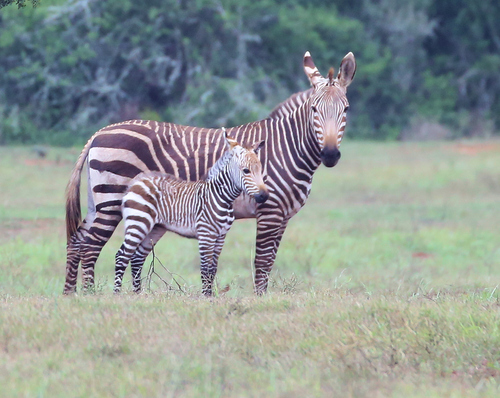
Mountain Zebra
Equus zebra
The Mountain Zebra is the rugged alpinist of the equine world, uniquely adapted with specialized hooves and bold 'gridiron' stripes to master the steep, rocky escarpments of southwestern Africa.
Quick Identification
Size
Shoulder height 1.16–1.5 m (3.8–4.9 ft); Weight 240–372 kg (530–820 lb)
Colors
Bold black and white stripes; white underbelly without stripes; reddish-tan muzzle; chestnut-colored stripes on the face
Key Features
- Distinctive dewlap (skin fold) on the throat
- Horizontal 'gridiron' stripe pattern on the rump
- White belly without any transverse stripes
- Hard, pointed hooves adapted for climbing
When You’ll See Them
Geographic range
Where Does the Mountain Zebra Live?
The Mountain Zebra is native to the southwestern reaches of the African continent, thriving in the rugged highlands of the Great Escarpment. Its range is divided between two distinct subspecies: the Cape mountain zebra, found in the mountainous regions of South Africa’s Western and Eastern Cape provinces, and Hartmann’s mountain zebra, which inhabits the arid, rocky ranges of Namibia and southwestern Angola. Unlike their plains-dwelling cousins, these zebras are restricted to these specialized mountain environments and have not been introduced elsewhere.
Basemap © OpenStreetMap contributors
Behavior
Mountain zebras are remarkable for their climbing ability, possessing hard, fast-growing hooves that allow them to navigate steep, rocky terrain with the agility of a mountain goat. Unlike the more common Plains Zebra, they live in small, stable breeding harems consisting of one adult stallion and up to five mares with their offspring. These groups are non-territorial, often overlapping in range with other families and bachelor groups.
They are primarily diurnal, spending their mornings and afternoons grazing and visiting water holes. Social grooming is a vital part of their day, helping to reinforce social bonds and maintain hygiene in hard-to-reach areas. They are also known for their love of dust baths, often returning to favored sandy patches to roll and coat their fur, which helps protect them from parasites and intense sun.
EverydayEarth exclusive
Camera Tips
To capture the Mountain Zebra on camera, you must think like a mountaineer. These animals follow established 'game trails' that wind through rocky passes or lead down to valley floors for water. Placing your camera at a height of 3.5 to 4 feet (approx. 1.2 meters) is ideal, as this aligns with their mid-body height and allows the camera to trigger on their movement before they pass the frame. A slight downward angle is helpful if the camera is positioned on a slope.
Focus your efforts near permanent water sources or mineral licks, especially during the dry season. Because Mountain Zebras are incredibly wary and have keen eyesight, ensure your camera is well-camouflaged and lacks any 'glow' from infrared LEDs that might spook them at night, although they are mostly active during the day. Using a camera with a fast trigger speed (under 0.5 seconds) is essential, as they can move surprisingly quickly when traversing slopes.
Consider setting your camera to take 3-photo bursts or 15-second videos. This is particularly rewarding for Mountain Zebras because it captures their social dynamics, such as mutual grooming or the stallion's protective behavior at the rear of the group. If you are in a particularly sunny area, orient the camera North to avoid the harsh African sun blowing out the white stripes in your images, which can cause 'white-out' on the sensor.
Similar Species
Species that look similar or are commonly confused with Mountain Zebra.
Frequently Asked Questions
Record Mountain Zebra at your habitat
Connect a camera to start building your own species record — AI identifies every visitor automatically.