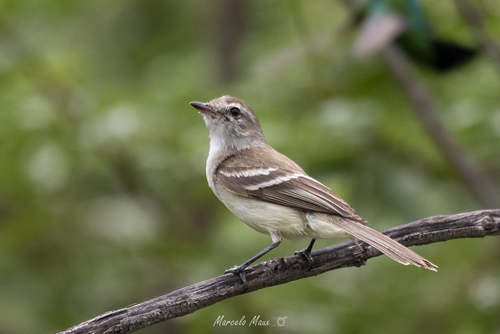
Mouse-colored Tyrannulet
Nesotriccus murinus
A master of camouflage, the Mouse-colored Tyrannulet is a charmingly understated flycatcher that thrives from the Panama Canal to the Argentine pampas.
Quick Identification
Size
Length: 12 cm (4.7 in); Wingspan: approx 18-20 cm (7-8 in); Weight: 10-12g (0.35-0.42 oz)
Colors
Drab brownish-gray upperparts and pale grayish to pale yellow underparts; wing feathers have thin buffy edges and two faint wing bars.
Key Features
- Dull, 'mouse-colored' gray-brown plumage
- Short, dark bill with a slight hook
- Two indistinct pale wing bars
- Faint whitish supercilium or 'eyebrow' above a dark eye-streak
When You’ll See Them
Geographic range
Where Does the Mouse-colored Tyrannulet Live?
This versatile flycatcher is native to the Neotropical realms of Central and South America. Its range extends from the Pacific and Caribbean slopes of Costa Rica and Panama, sweeping across the northern reaches of Colombia and Venezuela, and down through the Amazon basin to central Brazil and northern Argentina. It is a lowland specialist that flourishes in various climates, from the humid tropics to seasonally dry scrublands.
Basemap © OpenStreetMap contributors
Behavior
The Mouse-colored Tyrannulet is a discreet and methodical inhabitant of the canopy and forest edges. Unlike more aggressive flycatchers, it moves with a quiet deliberation, often perching upright for long periods while scanning for movement. It is typically found foraging alone or in pairs, and while it isn't overly shy, its cryptic coloration makes it one of the most overlooked birds in its range.
Its social behavior is characterized by its vocalizations rather than visual displays. They are frequently heard before they are seen, emitting a distinctive, sneezing 'pish' or a series of sharp, rising whistles. In suburban environments, they have proven remarkably resilient, often adapting to gardens and city parks as long as there is sufficient shrubbery for nesting and foraging.
EverydayEarth exclusive
Camera Tips
To capture high-quality footage of a Mouse-colored Tyrannulet, focus your camera on 'perch-and-sally' points. Look for exposed, thin twigs at the edge of a garden or clearing about 5 to 10 feet off the ground. These birds often return to the same favorite lookout point after darting out to catch an insect, making it the perfect spot for a motion-activated trigger.
Because these birds are small and move with quick, jerky motions, set your camera to its highest possible shutter speed or 'burst mode.' If your camera supports 4K video, use it—the subtle gray-on-gray markings that distinguish this species from other flycatchers can be difficult to see in low-resolution shots. Aim for an angle that captures the profile of the head to clearly see the short bill and faint eyebrow.
While they don't visit seed feeders, you can attract them to a camera site by providing a shallow, elevated birdbath. They are particularly active bathers during the hottest part of the early afternoon. Positioning your camera near native fruiting shrubs, such as those that produce small berries, will also increase your chances of capturing feeding behavior during the dry season when insects may be less abundant.
Similar Species
Species that look similar or are commonly confused with Mouse-colored Tyrannulet.
Frequently Asked Questions
Record Mouse-colored Tyrannulet at your habitat
Connect a camera to start building your own species record — AI identifies every visitor automatically.