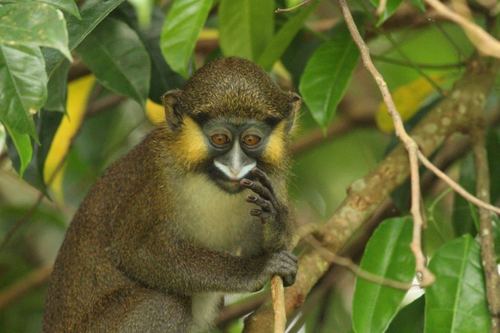
Moustached Monkey
Cercopithecus cephus
Meet the 'masked' acrobat of the African canopy, known for its striking blue eyes and iconic white moustache. These social primates are the life of the rainforest, often found traveling in multi-species troupes.
Quick Identification
Size
Body length of 48-56 cm (19-22 in); tail length of 65-70 cm (26-28 in); weight ranges from 2.5-4 kg (5.5-9 lbs)
Colors
Olive-brown to grayish-brown coat with a white or yellow sub-nasal 'moustache' and vibrant blue skin surrounding the eyes.
Key Features
- Distinctive white or yellow horizontal bar across the upper lip
- Vibrant sky-blue skin surrounding the eyes
- Long reddish-brown tail often twice the body length
- Yellow-tinted cheek fur
When You’ll See Them
Geographic range
Where Does the Moustached Monkey Live?
The Moustached Monkey is a signature species of the lush tropical heart of Central Africa. Its core range spans from the Sanaga River in Cameroon, stretching eastward through the Central African Republic and Gabon, and extending deep into the Republic of the Congo and the northern regions of the Democratic Republic of the Congo. It is also found in the northern enclave of Angola and on the island of Bioko in Equatorial Guinea. This species thrives in areas where the forest canopy is dense enough to provide both a diverse menu of fruit and protection from aerial predators.
Basemap © OpenStreetMap contributors
Behavior
A fascinating aspect of their behavior is their tendency to form polyspecific associations. This means they often travel and forage alongside other guenon species, such as Greater Spot-nosed monkeys or Red-tailed monkeys. By grouping together, they increase their chances of spotting predators and finding patchy food sources in the dense African rainforest, while the different species often focus on slightly different food types to avoid direct competition.
EverydayEarth exclusive
Camera Tips
While baiting is rarely used for these primates in a wild setting, placing a camera near a fruiting Fig (Ficus) or Uapaca tree during its peak season will significantly increase your success rate. These monkeys are creatures of habit and will revisit high-yield food sources daily until the fruit is depleted. Because they move quickly through the branches, ensure your camera is set to a high trigger speed and consider a multi-shot 'burst' mode or high-definition video to catch the subtle blue and white facial markings that distinguish them from other guenons.
Lighting in the rainforest can be challenging due to the thick canopy cover. If your camera allows for adjustable sensitivity, set it to trigger more easily during the low-light hours of dawn and dusk when the troop is most active. Avoid using a bright white flash at night as it may startle the troop if they are sleeping nearby; high-quality infrared sensors are preferred to capture natural behavior without causing distress to the group.
Similar Species
Species that look similar or are commonly confused with Moustached Monkey.
Frequently Asked Questions
Record Moustached Monkey at your habitat
Connect a camera to start building your own species record — AI identifies every visitor automatically.