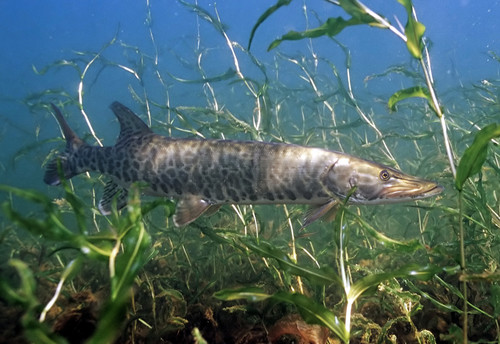
Muskellunge
Esox masquinongy
The ghost of the north woods, the Muskellunge is North America's most formidable freshwater predator. Witness the power and stealth of this legendary 'fish of ten thousand casts' in its natural underwater haunt.
Quick Identification
Size
71–122 cm (28–48 in) long; weight typically 6.8–16.3 kg (15–36 lbs), with record specimens exceeding 180 cm (70 in) and 30 kg (70 lbs)
Colors
Light silver, olive, or brown base color with dark vertical bars, spots, or mottled patterns; belly is typically cream or white
Key Features
- Long, torpedo-shaped body with a flat head
- Vertical dark bars or spots on a light background
- Pointed tail lobes and fins
- Six to nine sensory pores on the underside of each lower jaw
- Mouth filled with large, razor-sharp teeth
When You’ll See Them
Geographic range
Where Does the Muskellunge Live?
Native to the freshwater ecosystems of North America, the Muskellunge is primarily concentrated within the Great Lakes basin and the St. Lawrence River drainage. Its core range spans the upper Midwestern United States, particularly the lake-rich regions of Wisconsin, Minnesota, and Michigan, and extends northward into the southern provinces of Canada, including Ontario and Quebec. Outside of its native heartland, the species has been successfully introduced to various deep-water reservoirs and river systems throughout the eastern United States to support recreational trophy fishing.
Basemap © OpenStreetMap contributors
Behavior
The Muskellunge is the undisputed apex predator of its freshwater domain. Known for its solitary and highly territorial nature, it spends much of its time lurking in the shadows of submerged logs or thick weed beds. As an ambush hunter, it utilizes a 'sit-and-wait' strategy, remaining perfectly still for hours before accelerating with explosive speed to seize its prey. Its legendary reputation as the 'fish of ten thousand casts' stems from its cautious nature; a Muskie may follow a lure or a prey item right to the water's edge without ever striking, simply observing with keen intelligence.
Muskies are most active when water temperatures are between 60°F and 70°F (15°C–21°C), though they remain active hunters even under the ice in winter. While they are generally wary of humans, their massive size and sharp teeth require respect from anglers. In social terms, they are largely unsociable, only coming together in the spring to spawn in shallow, vegetated floodplains or marshy areas.
EverydayEarth exclusive
Camera Tips
To capture the elusive Muskellunge on an underwater trail camera, placement is everything. Focus on 'structural transitions'—the areas where a shallow weed bed (especially broad-leafed 'cabbage' weeds) drops off into deeper water. Muskies use these edges as highways and hunting grounds. Mount your camera on a weighted base or a dock piling at a depth of 3 to 6 feet, angling it slightly downward to capture the full silhouette of any fish passing through the strike zone.
Because Muskies are naturally curious but easily spooked, avoid using bright white LED lights at night. Instead, rely on natural light during the 'golden hours' of dawn and dusk, or use high-quality infrared sensors if your camera supports them. If you are placing a camera near a backyard dock, try to position it near a submerged light source, which attracts baitfish; the Muskie will eventually follow the food source into your frame.
While you shouldn't use traditional 'bait' in the water, you can use visual lures to bring a Muskellunge into view. A large, shiny spoon or a heavy flash-tape streamer suspended 5 feet in front of the lens can act as a curiosity attractor. Ensure your camera is set to record high-frame-rate video (60fps or higher) because their strike is faster than the human eye can track, and standard photo modes often result in a blurred tail or a missed shot entirely.
Seasonality plays a major role in camera success. In the late spring, position cameras in shallow, marshy bays where they spawn. During the heat of summer, move cameras to deeper rock reefs or the windward side of islands where the water is more oxygenated. In the fall, Muskies move back into the shallows to gorge themselves before winter, making this the best time to capture high-energy hunting behavior near shorelines.
Similar Species
Species that look similar or are commonly confused with Muskellunge.
Frequently Asked Questions
Record Muskellunge at your habitat
Connect a camera to start building your own species record — AI identifies every visitor automatically.