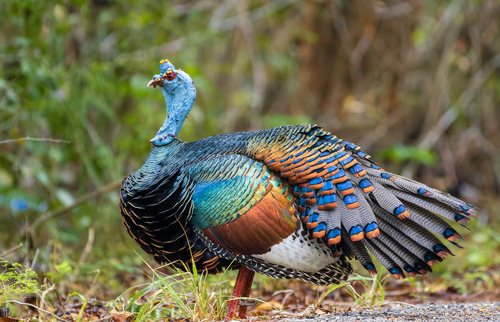
Ocellated Turkey
Meleagris ocellata
Meet the peacock of the turkey world. With its shimmering iridescent feathers and striking blue-and-orange head, the Ocellated Turkey is a tropical masterpiece waiting to be discovered.
Quick Identification
Size
70–122 cm (28–48 in) long; Males weigh approx. 5 kg (11 lbs), Females approx. 3 kg (6.6 lbs)
Colors
Iridescent bronze and emerald green body plumage; sky-blue head and neck adorned with orange or red nodules; tail feathers tipped with blue and gold eye-spots (ocelli).
Key Features
- Distinctive eye-like spots (ocelli) on tail feathers
- Bright blue head with orange-red fleshy caruncles
- Iridescent metallic green and bronze body feathers
- Lack of a 'beard' commonly found on North American turkeys
- Sharp, high-pitched whistling song instead of a traditional gobble
When You’ll See Them
Behavior
Ocellated Turkeys are ground-dwelling birds that spend the majority of their day foraging in small groups. They are significantly more social during the non-breeding season, often found in flocks of up to 20 individuals. Unlike their northern cousins, they are known for a unique vocalization that begins with a series of low-frequency 'thumps' and accelerates into a high-pitched, melodic whistling sound. They are surprisingly agile and, while they prefer to run from danger, they are capable of fast, short-distance flight to reach the safety of high tree canopies where they roost at night.
During the breeding season, which typically occurs between March and May, males perform elaborate displays to attract hens. They vibrate their wings against the ground and fan their magnificent 'eyed' tails, much like a peacock. While they are generally wary of humans in the wild, they have been known to become quite habituated to people in protected archaeological zones and rural villages, where they may confidently wander through clearings or along forest edges in search of food.
EverydayEarth exclusive
Camera Tips
To capture the stunning iridescence of the Ocellated Turkey, camera placement is everything. Position your camera approximately 18 to 24 inches off the ground, angled slightly upward. This 'turkey-eye-view' ensures you capture the intricate details of their blue heads and the metallic sheen of their feathers. Look for natural clearings at the edge of dense brush or 'dusting' spots—shallow depressions in dry soil where the birds bathe to remove parasites. These are high-traffic areas that guarantee consistent captures.
Because these birds are active during the day, lighting is your best friend and your worst enemy. If possible, face your camera North or South to avoid the direct 'washout' of the intense tropical sun. The most breathtaking shots occur during the 'golden hours' of the early morning or late afternoon when the low-angle light hits their metallic plumage, making the greens and bronzes pop. Use a fast trigger speed (0.5 seconds or less) and set your camera to 'Burst Mode' or 'Photo + Video' to capture the quick, jerky movements of their heads as they forage.
If you are in an area where it is legal and appropriate to do so, a small amount of cracked corn or wild bird seed can keep a flock in front of your lens for much longer. However, the best 'lure' is often a clean, shallow water source during the dry season. These birds need to drink daily, and a well-placed camera near a secluded forest puddle can result in incredible footage of social interactions and drinking behavior. Keep the camera's PIR sensitivity on 'High' to detect their movement from a distance as they approach the clearing.
Similar Species
Species that look similar or are commonly confused with Ocellated Turkey.
Frequently Asked Questions
Record Ocellated Turkey at your habitat
Connect a camera to start building your own species record — AI identifies every visitor automatically.