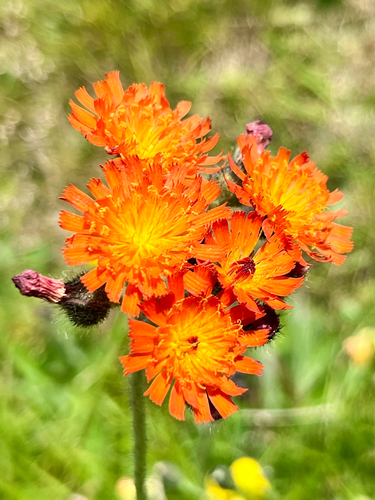
orange hawkweed
Pilosella aurantiaca
With its fiery orange petals and peculiar black-haired stems, the Orange Hawkweed is one of the most visually striking wildflowers you can find in a backyard meadow. A master of survival, this alpine native brings a splash of sunset color to the landscape from mid-summer through early autumn.
Quick Identification
Size
15-60 cm (6-24 inches) tall with flower heads 1-2 cm (0.5-0.75 inches) wide
Colors
Brilliant orange to deep reddish-orange petals; stems and buds covered in distinctive blackish hairs
Key Features
- Clusters of 5-30 vibrant orange flower heads
- Stems and flower buds covered in stiff, black glandular hairs
- Basal rosette of fuzzy, spatula-shaped leaves
- Milky sap produced when stems are broken
When You’ll See Them
Geographic range
Where Does the orange hawkweed Live?
Native to the alpine and subalpine regions of Central and Southern Europe, Orange Hawkweed is a high-altitude specialist in its original home, spanning from the Pyrenees to the Carpathians. However, it has become a widespread naturalized species across much of North America, particularly in the northern United States and across Canada, where it thrives in cooler temperate climates. It has also established significant populations in the United Kingdom, Scandinavia, New Zealand, and parts of Australia, often appearing in areas with high rainfall and acidic soils.
Basemap © OpenStreetMap contributors
Behavior
Orange Hawkweed is a perennial herb known for its aggressive spreading tactics and stunning floral display. Unlike many wildflowers that rely solely on seeds, this species utilizes a three-pronged approach to expansion: it sends out creeping stems called stolons (runners), spreads through underground rhizomes, and produces wind-dispersed seeds. This allows a single plant to quickly form a dense mat that can crowd out native vegetation and garden turf alike.
The flowers are highly sensitive to light and weather conditions. They typically open in the early morning to greet the sun and close tightly by late afternoon or during overcast, rainy weather to protect their pollen. This "sleeping" behavior makes them a dynamic subject for observation, as the appearance of a patch can change drastically over the course of twelve hours.
While it is celebrated as a protected alpine beauty in its native European range, in other parts of the world, it is often viewed as a stubborn weed. Its ability to thrive in nutrient-poor, acidic soils where other plants struggle makes it a pioneer species of sorts, often being the first to colonize disturbed roadsides or neglected pastures.
EverydayEarth exclusive
Camera Tips
To capture the true brilliance of Orange Hawkweed, position your camera at a low angle, roughly 6 to 10 inches from the ground. This perspective highlights the unique "hairy" texture of the stems and buds, which is one of the plant's most identifying features. If your AI camera has a macro or close-focus mode, use it to get crisp detail on the black glandular hairs that give the plant its nickname, "Devil's Paintbrush."
Setting up a time-lapse is the most rewarding way to monitor this species. Program your camera to take a shot every 15 to 30 minutes during the daylight hours. This will allow you to document the dramatic opening of the flower heads in the morning and their closing in the afternoon. Since the orange color is incredibly saturated, try to position the camera so the sun is behind you or to the side; direct mid-day overhead sun can sometimes cause the vibrant orange to "blow out" or lose detail in digital sensors.
Orange Hawkweed is a magnet for pollinators, particularly small sweat bees, hoverflies, and fritillary butterflies. To capture wildlife interactions, set your camera's trigger sensitivity to high and use a fast shutter speed. Because the plant grows in clusters, frame your shot to include 3-5 flower heads; this increases the likelihood that a visiting insect will land within your focal plane. During the peak blooming months of June and July, you can expect frequent activity from dawn until the flowers close in the late afternoon.
Similar Species
Species that look similar or are commonly confused with orange hawkweed.
Frequently Asked Questions
Record orange hawkweed at your habitat
Connect a camera to start building your own species record — AI identifies every visitor automatically.