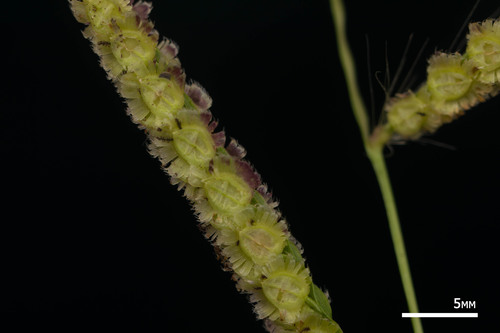
panama crowngrass
Paspalum fimbriatum
Characterized by its unique winged seeds and resilient nature, Panama Crowngrass is a fascinating tropical grass that brings architectural beauty and local birdlife to backyard edges.
Quick Identification
Size
20 to 100 cm (8 to 40 inches) in height with seed branches 2 to 7 cm (0.8 to 2.7 inches) long
Colors
Bright green blades; mature seed heads are tan to light brown; stem bases often show a reddish or purplish tint
Key Features
- 3 to 8 spreading flower branches (racemes) arranged alternately
- Spikelets featuring distinct papery, fringed wings along the margins
- Flat leaf blades reaching up to 12mm in width
- Tufted or clump-forming growth habit
When You’ll See Them
Geographic range
Where Does the panama crowngrass Live?
Panama Crowngrass is native to the tropical Americas, with its core range extending from Central America and the Caribbean through northern South America, including countries like Panama, Colombia, and Brazil. In North America, it has become well-established in the humid environments of Florida and Hawaii. It is also frequently encountered as an introduced species across various Pacific islands and parts of Southeast Asia.
Basemap © OpenStreetMap contributors
Behavior
Panama Crowngrass is an opportunistic annual grass known for its rapid life cycle and ability to quickly colonize open or disturbed soil. It is a common sight in suburban backyards across the tropics and subtropics, where it often thrives in the transition zones between manicured lawns and wilder garden edges. While it doesn't move like the animals usually captured on trail cameras, its growth behavior is highly dynamic, responding quickly to seasonal rains with a burst of tall, architectural seed heads.
Ecologically, this species serves as a vital food source for a variety of granivorous (seed-eating) birds and small rodents. Its social 'interaction' with the environment is primarily through its prolific seed production; the fringed wings on its seeds allow them to be easily dispersed by wind, water, or by clinging to the fur of passing wildlife and the clothing of humans. In many regions, it is considered a naturalized weed, but it plays a role in soil stabilization in recently cleared areas.
EverydayEarth exclusive
Camera Tips
Capturing the beauty of Panama Crowngrass with an AI camera requires a focus on macro-level detail. To showcase the unique 'fringed' spikelets that give the plant its name, position your camera on a small tripod or stake just 12 to 24 inches from the seed heads. An upward angle against a clear sky or a contrasting dark hedge will help the AI accurately identify the fine, wing-like margins of the seeds, which are the primary diagnostic feature of the species.
Because the tall stalks of Panama Crowngrass are highly sensitive to the wind, they can often trigger motion-sensitive cameras accidentally. To avoid a memory card full of 'false positives,' set your camera to a higher trigger speed or use a 'Time Lapse' mode during the morning hours. If you are specifically looking to capture the wildlife that uses this grass, aim your camera at a patch that has recently gone to seed, as this will attract finches, sparrows, and buntings.
Lighting is the most important factor for botanical photography. The 'fringed' edges of the seeds are best highlighted by backlighting or strong side-lighting. Try to capture your images during the golden hour—the first hour after sunrise or the last hour before sunset—when the low sun angle will make the tan-colored seed heads appear to glow. This high contrast makes for stunning images that stand out in any digital backyard gallery.
If you want to observe the entire life cycle, place your camera in an area of the yard that isn't frequently mowed, such as along a fence line or near a compost pile. Over several weeks, you can record the transition from the first green shoots to the spreading 'crown' of the mature seed head. Ensure the lens is clean and free of morning dew to maintain the sharpness needed for identifying the subtle textures of the grass.
Frequently Asked Questions
Record panama crowngrass at your habitat
Connect a camera to start building your own species record — AI identifies every visitor automatically.