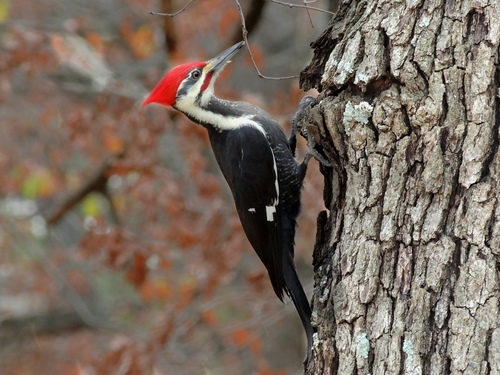
Pileated Woodpecker
Dryocopus pileatus
A prehistoric-looking giant of the North American woods, the Pileated Woodpecker is as famous for its flaming red crest as it is for its ability to reshape the forest one tree at a time.
Quick Identification
Size
Length: 40 to 49 cm (16 to 19 in); Wingspan: 66 to 75 cm (26 to 30 in); Weight: 250 to 350 g (8.8 to 12.3 oz)
Colors
Predominantly black body with bold white stripes on the face and neck. Both sexes feature a brilliant red crest. Males are distinguished by a red stripe (mustache) extending from the bill and a red forehead, while females have a black forehead and mustache.
Key Features
- Distinctive flaming red triangular crest
- Large, crow-sized body with mostly black plumage
- Prominent white underwing patches visible in flight
- Deep, rectangular-shaped excavations in dead wood
When You’ll See Them
Sightings on EverydayEarth
Jun 16, 2026
A Pileated Woodpecker is perched on the feeder tray, clinging to the central wooden post. It scans its surroundings with its head turning side to side before investigating the food items provided on the tray, including an orange half.
May 24, 2026
A very active afternoon at the bird feeders. A Red-bellied Woodpecker and a Hairy Woodpecker are feeding on the suet blocks, while a Red-winged Blackbird stands on the center ledge. A Mourning Dove sits quietly in the bottom tray. In the background, a large Pileated Woodpecker briefly lands on a post near the water before flying away.
May 24, 2026
A busy afternoon at the feeders features a large Pileated Woodpecker perched prominently on the central post, looking around cautiously. European Starlings visit both the suet feeder on the left and the main tray, while a Red-bellied Woodpecker clings to the tube feeder on the right. A Red-winged Blackbird makes a brief landing on top of the central suet cage before flying off.
May 15, 2026
A large Pileated Woodpecker perches in the tray feeder, investigating the seed and turning its head. To the right, a European Starling lands on a tube feeder to forage briefly before moving off-camera.
Apr 20, 2026
A male Pileated Woodpecker is the primary visitor, perched in the tray feeder and feeding on the provided seed. A Common Grackle flies in and lands briefly on the central feeder pole before moving to a tube feeder and departing. Simultaneously, a Downy Woodpecker is visible foraging on the hanging suet feeder to the far left.
Behavior
The Pileated Woodpecker is a powerful and charismatic presence in the forest, known for its loud, resonant drumming and its wild, laughing call. These birds are master architects of the woods, using their chisel-like bills to hack deep into soft, decaying wood. Their work is so extensive that they often create large, rectangular cavities that provide essential nesting and roosting spots for dozens of other species, from screech owls to wood ducks.
While they can be shy in deep forests, they have increasingly adapted to suburban areas that maintain mature trees. They are generally solitary or found in pairs, maintaining large territories that they defend vigorously year-round. Watching them forage is a spectacle; they don't just peck at the bark—they tear it away in large chunks, often sending wood chips flying in a rhythmic display of strength that sounds like a carpenter at work.
EverydayEarth exclusive
Camera Tips
To successfully capture a Pileated Woodpecker on your AI camera, you must focus on their unique physical requirements. Standard bird feeders are often too small for these crow-sized birds, and they rarely visit them. Instead, mount a high-quality suet feeder equipped with a "tail prop"—a long piece of wood below the feeder that allows the woodpecker to balance using its stiff tail feathers. Position your camera 5 to 8 feet off the ground on a nearby trunk, angled slightly downward to capture the bird's full profile as it lands and feeds.
If you have a dead tree or "snag" on your property, this is the gold mine for camera placement. Look for the tell-tale rectangular holes they carve while hunting carpenter ants. Mount your camera on a neighboring tree about 10-15 feet away to get a wide enough field of view to capture their dramatic movements. Because Pileated Woodpeckers are diurnal and most active in the early morning, ensure your camera's exposure settings are optimized for the high-contrast lighting of a forest canopy to avoid "blowing out" the white stripes on their faces against the dark wood.
For the most engaging footage, use the video mode on your camera. The sight of a Pileated Woodpecker hammering into wood is much more impressive in motion than in a still photo. Set your trigger sensitivity to high, as their approach is often a swift, direct flight that can be missed by slower sensors. If you're using a suet lure, high-fat "no-melt" varieties are best during the summer, while standard beef suet is a magnet during the colder months when their natural insect prey is harder to find inside frozen logs.
Similar Species
Species that look similar or are commonly confused with Pileated Woodpecker.
Frequently Asked Questions
Record Pileated Woodpecker at your habitat
Connect a camera to start building your own species record — AI identifies every visitor automatically.