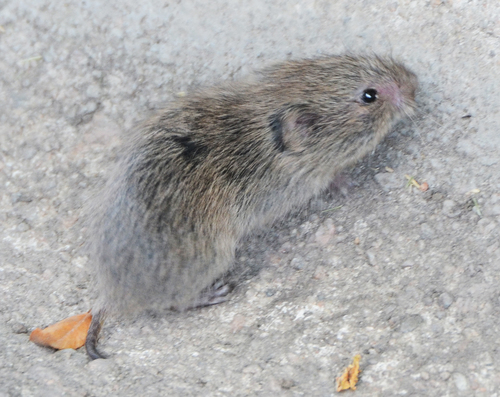
Prairie Vole
Microtus ochrogaster
The Prairie Vole is a social architect of the grasslands, famous for its lifelong pair bonds and intricate tunnel systems. These stocky, grizzled rodents bring a hidden world of communal living right to the edges of our suburban lawns.
Quick Identification
Size
13-18 cm (5-7 inches) total length; tail 3-4 cm (1.2-1.6 inches); weight 35-50 g (1.2-1.8 oz)
Colors
Grizzled brownish-gray fur on the back with a distinct yellowish or orange tint on the belly and underparts.
Key Features
- Grizzled brownish-gray coat with orange-tinted belly
- Short tail, roughly 25-30% of total body length
- Small ears partially hidden by fur
- Stocky, compact body with a blunt snout
When You’ll See Them
Behavior
Prairie Voles are famously social mammals, known for forming long-term monogamous pair bonds—a rarity in the rodent world. They live in complex underground burrow systems with multiple entrances, which are often connected by 'runways' or narrow, worn paths through the tall grass. Unlike many other small rodents that are strictly nocturnal, Prairie Voles are active at intervals throughout the day and night, making them fascinating subjects for backyard observation.
In a backyard setting, they are shy and usually stay close to cover to avoid predators like hawks, owls, and foxes. They are highly territorial within their colony and use scent marking to define their space. While they generally avoid direct contact with humans, they can become quite accustomed to living in suburban gardens where tall grasses, dense mulch, or ground covers provide adequate protection and food sources.
EverydayEarth exclusive
Camera Tips
To capture these elusive tunnel-dwellers, your best bet is to look for their 'runways'—distinct, narrow paths about two inches wide worn into the grass or mulch. Place your camera just a few inches off the ground, angled slightly downward toward one of these runways or near a burrow entrance. Because Prairie Voles are small and move with a quick scuttling motion, use a camera with a high trigger speed (0.2 seconds or less) to ensure you don't just catch a blurry tail.
Since they are active during both day and night, ensure your camera's infrared settings are optimized for close-up night shots. Often, a 'Macro' or 'Close-up' lens attachment is helpful because standard trail cameras usually have a minimum focus distance of 3-5 feet, which can result in blurry images of such a small subject. If your camera allows it, set it to 'Burst Mode' or short video clips (10-15 seconds) to catch their social interactions, as you will often see mated pairs or family groups traveling together.
While you don't necessarily need bait, a small handful of birdseed or a piece of apple placed directly in a runway can encourage them to pause long enough for a clear photo. During the winter, look for areas where the snow has melted away near south-facing walls or fences; these 'subnivean' tunnels often open up here, providing a great opportunity to see them when other wildlife is scarce. Position your camera about 2-3 feet away from the target site to keep the subject in focus while maintaining a wide enough field of view to see the surrounding habitat.
Similar Species
Species that look similar or are commonly confused with Prairie Vole.
Frequently Asked Questions
Record Prairie Vole at your habitat
Connect a camera to start building your own species record — AI identifies every visitor automatically.