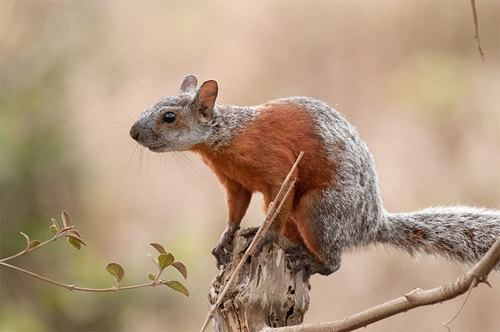
Red-bellied Squirrel
Sciurus aureogaster
With its striking chestnut underside and masterful climbing skills, the Red-bellied Squirrel is a vibrant highlight of the backyard canopy. A native of Mexico and Guatemala, this bold acrobat is a delight to watch as it navigates the treetops with ease.
Quick Identification
Size
Length 42–55 cm (16.5–21.5 in); Weight 500–750 g (1.1–1.6 lbs)
Colors
Dorsal fur is typically light to dark gray; ventral side (belly) ranges from bright orange to deep chestnut. Melanistic (all black) individuals are common in some populations.
Key Features
- Vibrant orange or red-brown underparts
- Large, bushy tail often frosted with white-tipped hairs
- Stocky body significantly larger than a common tree squirrel
- Distinctive gray 'saddle' across the back
When You’ll See Them
Behavior
The Red-bellied Squirrel, also known as the Mexican Gray Squirrel, is a highly agile and energetic tree-dweller. They are primarily arboreal, meaning they spend the majority of their lives in the canopy, leaping between branches with remarkable precision. Unlike some of their more timid cousins, these squirrels are quite bold and can often be heard chattering or barking to defend their territory from rivals or predators.
These squirrels are scatter-hoarders, a behavior that plays a vital role in forest regeneration. They spend significant time on the ground during the autumn months, burying nuts and seeds in various locations to sustain them through leaner periods. While they are generally solitary, they may congregate near abundant food sources, leading to playful—and sometimes aggressive—chases through the treetops.
EverydayEarth exclusive
Camera Tips
To capture the best footage of a Red-bellied Squirrel, think vertically. These animals use tree trunks as highways. Mount your camera about 4 to 5 feet high on a mature oak or nut-bearing tree, angling it slightly downward toward a sturdy horizontal branch or a known 'stopping point' where the squirrel pauses to scan the area. Avoid placing the camera too low on the ground unless you are targeting their caching behavior, as they are most comfortable and photogenic when elevated.
Baiting can be very effective for bringing them into frame. A small platform feeder stocked with whole walnuts, pecans, or sunflower seeds will keep them stationary long enough for high-quality shots. If you are in a drier climate or during a summer heatwave, a elevated birdbath or dripping water source is an irresistible magnet for these squirrels, providing excellent opportunities for capturing grooming and drinking behaviors.
Because squirrels are incredibly fast, camera settings are crucial. Use a fast trigger speed (0.3 seconds or less) and set your camera to 'Burst Mode' or 'Photo + Video' to ensure you don't just catch a blurry tail as they zip by. For video, a 15-second clip is usually sufficient to capture their erratic movements. Position your camera to face North or South to prevent harsh morning or afternoon sunlight from 'blowing out' the details of their gray fur and red bellies.
In suburban settings, look for 'squirrel bridges'—fence lines, utility wires, or overhanging branches that connect two foraging areas. Placing a camera near these transit points will yield frequent captures. During the winter, look for their large leaf nests (dreys) in the canopy; placing a camera on a nearby tree may capture them emerging at sunrise to begin their daily foraging rounds.
Similar Species
Species that look similar or are commonly confused with Red-bellied Squirrel.
Frequently Asked Questions
Record Red-bellied Squirrel at your habitat
Connect a camera to start building your own species record — AI identifies every visitor automatically.