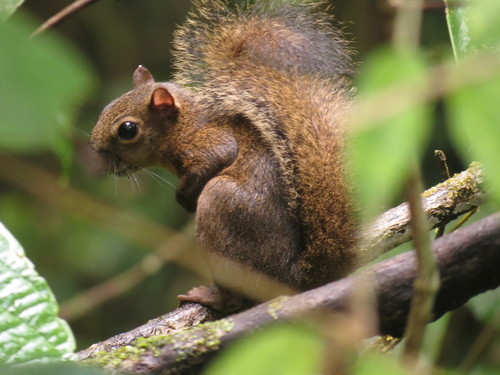
Richmond's Squirrel
Sciurus richmondi
The Richmond's Squirrel is a rare and beautiful endemic of Nicaragua's lush lowlands. Known for its rich mahogany coat and elusive nature, spotting one on camera is a true badge of honor for any backyard naturalist.
Quick Identification
Size
Body length of 18-22 cm (7-8.5 in) with a tail of 15-18 cm (6-7 in); weight typically ranges from 250-400g (9-14 oz)
Colors
Deep ochraceous-brown or dark mahogany upperparts; underparts are yellowish-buff or pale orange; tail is dark brown with subtle rufous frosting
Key Features
- Uniform dark brown dorsal coloration
- Lacks the white ear tufts found in some relatives
- Relatively short, bushy tail compared to body length
- Pale orange-buff belly with no white spotting
When You’ll See Them
Behavior
The Richmond's Squirrel, or 'ardilla del rama,' is an agile arboreal specialist that spends the vast majority of its life in the canopy. Unlike some of its more urban-adapted cousins, this species is somewhat shy and cautious, often freezing in place or spiraling to the opposite side of a tree trunk when it senses a potential threat. They are solitary by nature, though they may tolerate the presence of others near high-value food sources like fruiting Dipteryx trees.
These squirrels are incredibly industrious foragers, spending their morning hours leaping between branches with remarkable precision. While they are primarily tree-dwellers, they will occasionally descend to the forest floor to retrieve fallen nuts or bury caches for leaner times. In areas where human settlements border the forest, they may occasionally visit cacao or fruit plantations, showing a measured level of adaptability to modified landscapes.
EverydayEarth exclusive
Camera Tips
To capture the Richmond's Squirrel, camera placement is everything. Since they are primarily arboreal, mounting your AI camera 5 to 10 feet up a tree trunk is significantly more effective than ground placement. Use a specialized tree mount to angle the camera slightly downward toward a sturdy, horizontal limb that serves as a natural 'highway' between trees. Look for 'scat' or chewed nut shells at the base of trees to identify high-traffic areas.
While we recommend observing natural behavior, you can increase your capture rate by placing the camera near a known food source like a fruiting tree or a bird feeder stocked with black oil sunflower seeds or native nuts. If using a lure, place it on a branch about 3-5 feet from the lens to ensure the AI has enough time to trigger and focus. Because these squirrels move in quick, erratic bursts, set your camera to 'Burst Mode' or 'High Sensitivity' to capture the action before they vanish behind the trunk.
Lighting in the rainforest or dense canopy can be tricky. If your camera allows for it, adjust the exposure settings to account for the dappled sunlight which can often 'wash out' images. Late afternoon provides the best natural lighting for showing off the rich, mahogany tones of their fur. During the rainy season, ensure your camera housing is properly sealed, as the humidity in Nicaragua's lowland forests can be intense.
Similar Species
Species that look similar or are commonly confused with Richmond's Squirrel.
Frequently Asked Questions
Record Richmond's Squirrel at your habitat
Connect a camera to start building your own species record — AI identifies every visitor automatically.