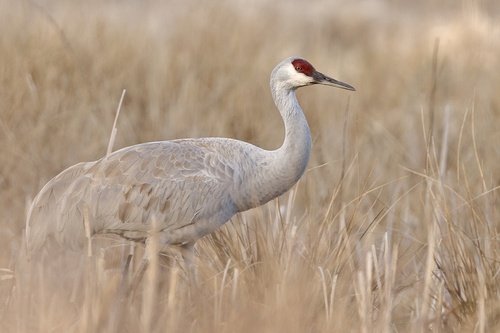
Sandhill Crane
Antigone canadensis
With their prehistoric trumpeting calls and elegant 'bustle' feathers, Sandhill Cranes are the tall, stately ambassadors of North America's wetlands and meadows.
Quick Identification
Size
Length: 3.3-3.9 ft (100-120 cm); Wingspan: 5.4-6.9 ft (165-210 cm); Weight: 6.5-14.5 lbs (3-6.5 kg)
Colors
Slate gray body plumage, often stained with rusty-iron mud; distinctive bright red forehead; white cheeks; black bill and legs.
Key Features
- Bright red featherless forehead patch
- Long, elegant neck and stilt-like black legs
- Drooping, 'bustle' style tail feathers
- Straight, heavy bill
When You’ll See Them
Sightings on EverydayEarth
Apr 16, 2026
A Sandhill Crane wades through the shallow water of a wide riverbed. It moves steadily from the left side of the frame toward the center, foraging along the edges of the submerged sandbars.
Apr 1, 2026
An adult Sandhill Crane is seen on its nest among reeds at the water's edge. A young chick, or colt, stands on the adult's back, navigating the feathers before hopping down into the nest material. The adult remains calm, occasionally adjusting the nest with its beak.
Mar 31, 2026
A massive congregation of Sandhill Cranes stands in the shallow water of a wetland. Many are resting or preening, while others are seen flying in and landing within the flock. Numerous smaller waterfowl are swimming in the background across the water's surface.
Mar 30, 2026
A large group of Sandhill Cranes is seen resting in the shallow water of a river at night. While several birds are clearly visible in the foreground, standing still or preening, a massive flock of thousands more stretches across the horizon, appearing as a shimmering white texture against the dark landscape.
Behavior
Sandhill Cranes are highly social birds known for their complex communication and lifelong pair bonds. One of their most famous behaviors is their elaborate courtship dance, which involves stretching their wings, pumping their heads, bowing, and leaping into the air. While these dances are most common during the breeding season, cranes of all ages may dance year-round to relieve stress or strengthen social bonds within the flock.
These birds are famous for their loud, rattling 'kar-r-r-o-o-o' calls, which can be heard from miles away thanks to a long, coiled windpipe that acts like a trumpet. They are generally wary of humans but have become increasingly bold in suburban areas, often seen foraging on golf courses or residential lawns. In the garden, they move with a slow, stately grace, probing the soil with their bills.
EverydayEarth exclusive
Camera Tips
Capturing a Sandhill Crane on camera requires planning for their impressive height. Since these birds stand nearly four feet tall, avoid placing your camera too low to the ground unless you angle it upward. A mounting height of 2-3 feet on a sturdy post or tree trunk is ideal. Because they are large-bodied, they can easily trigger motion sensors from a distance, so ensure your camera has a wide field of view to capture the whole bird rather than just a pair of long legs.
Placement is everything with cranes. Look for 'corridors' where they walk from water sources to feeding grounds. If you have a large backyard with a bird feeder, they may visit the ground underneath to glean spilled seeds. However, the best footage often comes from the edges of retention ponds or marshy areas in your neighborhood. They are creatures of habit and will often visit the same patch of grass at the same time every morning.
To capture their famous dancing behavior, use a 'Burst Mode' or 'Photo Series' setting. Their movements are sudden and energetic; a single photo might miss the peak of a leap, but a 3-5 photo burst is likely to catch that iconic mid-air pose. If your camera supports high-definition video, enable it with a 20-30 second clip duration to capture their unique rattling vocalizations, which are just as impressive as their visual appearance.
While it may be tempting to use corn or grain to lure them, we recommend against it in residential areas to prevent them from becoming too habituated to humans or crossing dangerous roads. Instead, focus on natural attractants like bird baths or keeping a patch of lawn slightly longer where they can probe for grubs and earthworms. During the summer months, keep an eye out for 'colts' (juvenile cranes), as the family units travel together and provide excellent multi-subject footage.
Similar Species
Species that look similar or are commonly confused with Sandhill Crane.
Great Blue Heron
Blue-gray color with no red head patch; flies with its neck tucked in rather than extended straight out.
Whooping Crane
Much rarer and larger; plumage is pure white with black wing tips, unlike the slate gray of the Sandhill.
Great Egret
Smaller, all-white plumage with a yellow bill and no red forehead.
Frequently Asked Questions
Record Sandhill Crane at your habitat
Connect a camera to start building your own species record — AI identifies every visitor automatically.