Sanguina nivaloides
Sanguina nivaloides
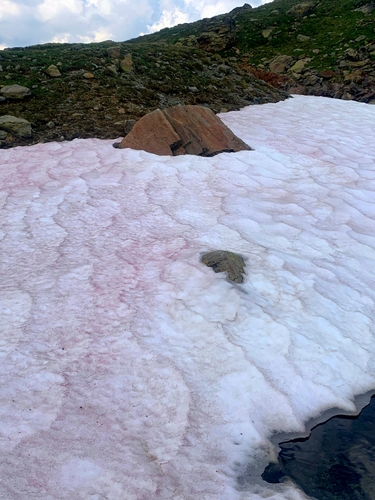
Witness the phenomenon of 'watermelon snow,' a vibrant red bloom of Sanguina nivaloides that thrives in the world's coldest environments. This resilient alga uses natural sunscreen to survive intense mountain sun, painting the peaks in stunning shades of crimson.
Quick Identification
Size
Individual cells are 10–35 micrometers in diameter; blooms can cover areas from a few square meters to several square kilometers.
Colors
Brilliant crimson, watermelon pink, or rust-red; occasionally orange in lower light conditions.
Key Features
- Vivid red or pink staining on summer snowpacks
- Faint, sweet scent of watermelon when snow is crushed
- Visible only during melting phases
- Microscopic spherical red resting cysts
When You’ll See Them
Geographic range
Where Does the Sanguina nivaloides Live?
Sanguina nivaloides has a cosmopolitan distribution across the high-altitude and high-latitude regions of the globe. It is native to the major mountain ranges of the world, most notably the Alps in Europe, the Rocky Mountains and Sierra Nevada in North America, and the Andes in South America. In addition to these alpine regions, the species is a dominant feature of polar landscapes across Antarctica, Greenland, and the Arctic territories of Canada, Norway, and Russia. While it is found globally, its appearance is strictly seasonal and tied to the presence of melting snow and ice.
Basemap © OpenStreetMap contributors
Behavior
Upon reaching the high-light environment of the snow surface, the algae lose their flagella and transform into thick-walled, red resting cysts. The striking red color is caused by astaxanthin, a carotenoid pigment that acts as a biological sunscreen, protecting the cell's DNA and chlorophyll from the intense ultraviolet radiation found at high altitudes and polar latitudes. This pigmentation also lowers the albedo of the snow, causing it to absorb more heat and melt faster, which in turn provides more water for the algae to thrive.
EverydayEarth exclusive
Camera Tips
Placement is critical: look for shaded areas near the edges of melting snowbanks where pinkish tints are just beginning to appear. Ensure your camera is mounted on a stable, non-sinking surface, such as a rock or a deeply driven stake, as the melting snow will cause the ground to shift. Angle the camera downward at a 45-degree angle toward the snow surface to capture the texture and color depth of the bloom.
Lighting can be a major challenge due to the high reflectivity of the snow. If your camera allows for manual exposure compensation, set it to -1.0 or -2.0 to prevent the white snow from blowing out and losing the red detail. Use a polarizing filter if possible to reduce glare. Since these algae thrive in the cold, ensure your camera has high-quality lithium batteries, which perform significantly better than alkaline in the freezing temperatures of high-altitude or polar environments.
Frequently Asked Questions
Record Sanguina nivaloides at your habitat
Connect a camera to start building your own species record — AI identifies every visitor automatically.