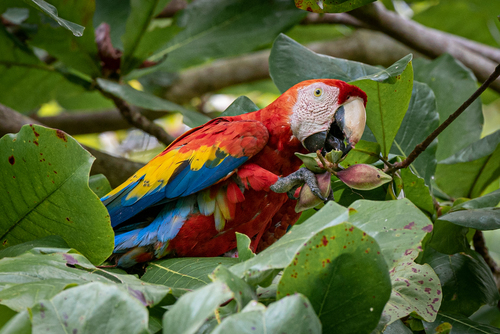
Scarlet Macaw
Ara macao
The Scarlet Macaw is a living masterpiece of the tropical canopy, boasting a brilliant palette of primary colors and an intelligence that rivals the world's smartest animals.
Quick Identification
Size
Length: 81–96 cm (32–38 in); Wingspan: 100–120 cm (39–47 in); Weight: 1 kg (2.2 lbs)
Colors
Brilliant scarlet red body; yellow wing coverts; blue flight feathers and rump; bare white facial skin
Key Features
- Bright yellow band across the mid-wing
- Extremely long, pointed red and blue tail
- Large, powerful hooked beak with a pale upper mandible
- Bare white skin patch around the eyes without feather lines
When You’ll See Them
Sightings on EverydayEarth
Jul 30, 2026
Two Scarlet Macaws are perched on a suspended wooden feeder tray, eating provided food. One bird on the left stands tall while the other on the right focuses on feeding from the metal dish. After a few seconds, the macaw on the left takes flight, causing the feeder to tilt and sway as it departs.
Jul 29, 2026
A vibrant Scarlet Macaw is seen perching on the edge of a suspended wooden feeder. It leans forward to feed on the provided food before shifting its position and moving partially out of view, with its long tail feathers swinging as it adjusts its footing.
Jul 28, 2026
Several Scarlet Macaws are active in the upper forest canopy. One bird perches briefly in the branches before taking flight, while others are seen flying across the background. Their loud, raucous calls are heard clearly over the sound of light rain falling through the trees.
Jul 26, 2026
A Black Spiny-tailed Iguana is perched calmly on a large horizontal branch in the foreground. In the background, a Scarlet Macaw is seen flying through the lush canopy, accompanied by the loud, raucous calls of several other macaws nearby.
Jul 26, 2026
A Scarlet Macaw is perched on a large tree limb on the right, observing its surroundings. To the left, another Scarlet Macaw is actively feeding at a tray mounted on a branch. A White-throated Magpie-Jay flies in and lands on the edge of the feeder tray, momentarily sharing the space with the feeding macaw.
Jul 25, 2026
Two Scarlet Macaws are seen visiting a wooden feeder tray suspended between moss-covered trees. They use their large beaks to sift through the contents of the tray, foraging for food while perched on the edge. Their brilliant red, yellow, and blue feathers stand out vividly against the tropical forest background.
Behavior
Scarlet Macaws are incredibly social and intelligent birds, often seen flying in pairs or small family groups. They are famous for their lifelong pair bonds; once they find a mate, they are rarely seen apart, even flying so close together that their wingtips almost touch. They communicate with a variety of loud, raucous screeches and squawks that can carry for miles through the dense jungle canopy.
In the wild, they spend much of their day foraging for food, using their powerful beaks as a 'third hand' to climb branches and crack open the toughest nuts. While they are wary of predators, they can become quite bold around humans if they feel safe, particularly in areas where they are protected or accustomed to supplemental feeding. They are also known to visit 'clay licks'—exposed riverbanks where they eat mineral-rich soil to neutralize toxins in their diet.
EverydayEarth exclusive
Camera Tips
Capturing a Scarlet Macaw on a trail camera requires a bit of elevation. Since these birds are primarily arboreal, a ground-level camera is unlikely to see much action unless it is pointed at a known water source or a fallen fruit tree. For the best results, mount your camera 10 to 15 feet high on a tree trunk or a sturdy pole, angled slightly downward toward a known feeding branch or a platform feeder stocked with tropical fruits like papaya or mango.
Because Macaws are fast flyers and highly active when feeding, camera settings are crucial. Use a camera with a lightning-fast trigger speed (0.3 seconds or less) to catch them as they land. If your camera supports it, opt for a high shutter speed to freeze the motion of those vibrant wings; otherwise, you may end up with a blurry red streak. Setting the camera to take 'burst' photos (3-5 frames per trigger) is the best way to ensure you get a perfectly composed shot of their profile.
Lighting is your best friend when photographing these birds. Their plumage is exceptionally reflective, so aim your camera toward the east or west to catch the golden hour light in the early morning or late afternoon. Avoid pointing the lens directly into the sun, as the high contrast can wash out the brilliant yellows and reds. If you are in a backyard setting, planting native trees like the Beach Almond (Terminalia catappa) is a surefire way to bring them within range of your lens year-round.
Similar Species
Species that look similar or are commonly confused with Scarlet Macaw.
Frequently Asked Questions
Record Scarlet Macaw at your habitat
Connect a camera to start building your own species record — AI identifies every visitor automatically.