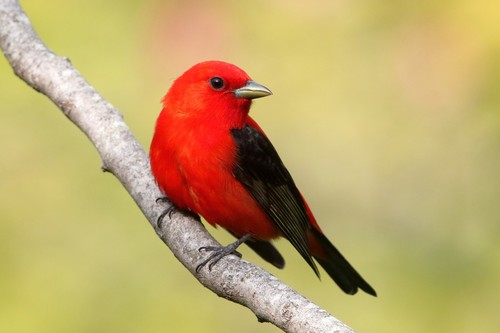
Scarlet Tanager
Piranga olivacea
A breathtaking flash of crimson against the forest green, the Scarlet Tanager is one of North America's most stunning migratory visitors. Known for their secretive nature high in the canopy, these birds are a prized capture for any backyard wildlife enthusiast.
Quick Identification
Size
Length: 16-19 cm (6.3-7.5 in); Wingspan: 25-30 cm (9.8-11.8 in); Weight: 23-38 g (0.8-1.3 oz)
Colors
Breeding males are brilliant scarlet with jet-black wings and tails. Females, immatures, and non-breeding males are olive-yellow with darker, dusky-colored wings.
Key Features
- Brilliant scarlet body with jet-black wings and tail (breeding males)
- Olive-yellow plumage with dark brownish-black wings (females)
- Stocky build with a relatively short, pale-colored beak
- Distinctive 'chick-burr' vocalization often heard before sighting
When You’ll See Them
Behavior
Scarlet Tanagers are often described as 'forest jewels' that are easier to hear than to see. They are somewhat shy and spend the majority of their time high in the forest canopy, moving deliberately through the leaves to forage for insects. While they are songbirds, their movements are often slow and methodical compared to the frantic hopping of warblers. During the breeding season, males are fiercely territorial and will sing from high perches to defend their space.
Despite their bright colors, they can be surprisingly difficult to spot among the dappled sunlight of oak and beech trees. They are largely solitary outside of the breeding season, though they may join mixed-species flocks during migration. In suburban settings, they are less common than cardinals, usually appearing only if there are large, mature deciduous trees nearby to provide the dense cover they prefer.
EverydayEarth exclusive
Camera Tips
Capturing the Scarlet Tanager on camera requires a strategic approach because they spend most of their lives in the upper story of the forest. The most effective way to bring them into camera range is by offering a water source. Use a birdbath with a 'dripper' or a small solar fountain; the sound of moving water is an irresistible magnet for tanagers during their spring migration in May. Position your camera about 3-5 feet away from the water source, angled slightly downward to capture the reflection of their vibrant red plumage.
If you have fruit-bearing trees or shrubs like serviceberry, mulberry, or blackberry, mount your camera nearby during the mid-to-late summer. Tanagers will descend from the canopy to feast on these berries before their long journey south. For the best lighting, try to position the camera so it faces North or South to avoid the harsh glare of the rising or setting sun, which can wash out the intense reds of the male’s feathers.
Because these birds are quick and cautious, set your AI camera to a high-sensitivity motion trigger and a fast shutter speed if the settings allow. Since they are canopy-dwellers, consider placing a 'treetop camera' if you have a balcony or a sloping yard that allows you to see into the middle branches of mature oaks. During the peak of migration in early May, keep your camera active throughout the day, as tired migrants are more likely to visit lower branches and birdbaths for a quick energy boost.
Similar Species
Species that look similar or are commonly confused with Scarlet Tanager.
Summer Tanager
The Summer Tanager male is entirely red without black wings, and the female is a brighter, more mustard-yellow compared to the olive-yellow Scarlet Tanager.
Northern Cardinal
Cardinals have a distinct pointed crest, red wings, and a black face mask, none of which are present on a Scarlet Tanager.
Vermilion Flycatcher
Much smaller with a dark mask and brown wings; found primarily in the Southwest U.S. and Mexico.
Frequently Asked Questions
Record Scarlet Tanager at your habitat
Connect a camera to start building your own species record — AI identifies every visitor automatically.