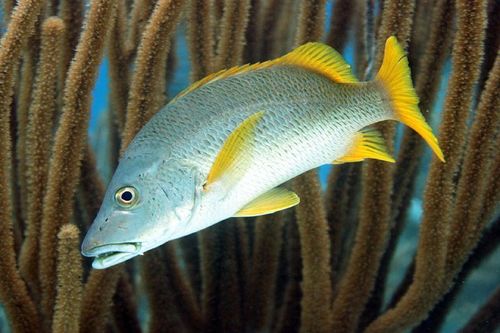
Schoolmaster Snapper
Lutjanus apodus
A golden-finned sentinel of the reefs and mangroves, the Schoolmaster Snapper is one of the most social and recognizable fish in the western Atlantic. Whether schooling by day or hunting by night, their striking yellow markings make them a prized sight for any coastal observer.
Quick Identification
Size
Typically 12-14 inches (30-35 cm), but can reach up to 24 inches (60 cm) and weigh up to 8 lbs (3.6 kg).
Colors
Silver to bronze body with distinctive bright yellow fins. Younger individuals show 8-10 pale vertical bars on their sides, and a faint blue line is often visible under the eye.
Key Features
- Bright yellow dorsal, anal, and caudal fins
- 8-10 pale vertical bars along the flanks
- Thin blue horizontal line under the eye
- Large, visible canine teeth in the upper jaw
When You’ll See Them
Sightings on EverydayEarth
Jul 26, 2026
A vibrant underwater scene shows several fish active on the reef. A Schoolmaster Snapper hovers near the base of a large sea fan at the bottom of the frame. A bright yellow Caribbean Bluehead Wrasse swims quickly past the purple sea fans, followed shortly after by a colorful Princess Parrotfish that traverses the frame from right to left.
Jul 26, 2026
A vibrant reef scene is filled with activity. A Schoolmaster snapper swims slowly near the bottom among sea fans and coral. In the water column above, schools of Blue Chromis and yellow Bluehead Wrasse dart around. A Bicolor Damselfish is visible near the reef structure in the lower left, while a Sergeant Major passes through the upper right of the frame.
Behavior
The Schoolmaster Snapper is a highly social species, often found in large, stationary groups during the daylight hours. These schools typically congregate around submerged structures like coral heads, mangrove roots, or dock pilings. While they appear sedentary during the day, this is a defensive social strategy to avoid larger predators while they rest.
As night falls, the schools disperse, and the Schoolmaster becomes a solitary and efficient hunter. They are opportunistic predators that prowl the sea floor and reef edges. In areas with high human activity, such as public piers or coastal backyards, they can become quite bold, often learning to associate humans with potential food scraps, though they remain wary of sudden movements.
EverydayEarth exclusive
Camera Tips
Capturing the Schoolmaster Snapper requires an underwater camera setup or a specialized dock camera. For those with waterfront property, the best placement is directly against a dock piling or nestled within the prop roots of mangroves. These fish love 'edge' habitats, so aim your lens where the structure meets the open sandy bottom. Mounting the camera about 2 to 4 feet below the low-tide line ensures the species remains in frame regardless of tidal fluctuations.
To get the best footage, timing is everything. While they school during the day, their most interesting predatory behaviors occur at night. Use a camera with high-quality infrared (IR) capabilities to avoid scaring them with bright white lights, which can cause 'flare' off their reflective scales. If you are using a trigger-based system, set the sensitivity high, as their silver bodies can sometimes blend into the background of moving water.
Attracting Schoolmaster Snapper to your camera's field of view is best done with a perforated bait scent container rather than loose food. A small cage filled with crushed shrimp or fish carcasses will keep the fish in front of the lens for extended periods without the 'hit and run' feeding style that leads to blurry photos. Place the bait roughly 3 feet from the lens to ensure they are within the focal range and to provide enough scale to see their yellow fins clearly.
Finally, consider the tide and water clarity. The best footage is usually captured during 'incoming' tides when clearer oceanic water moves into coastal areas. In murky water, the autofocus on many AI cameras may struggle; if possible, use a fixed-focus setting locked at 3-5 feet to ensure the Snappers are crisp as they pass by your station.
Similar Species
Species that look similar or are commonly confused with Schoolmaster Snapper.
Frequently Asked Questions
Record Schoolmaster Snapper at your habitat
Connect a camera to start building your own species record — AI identifies every visitor automatically.