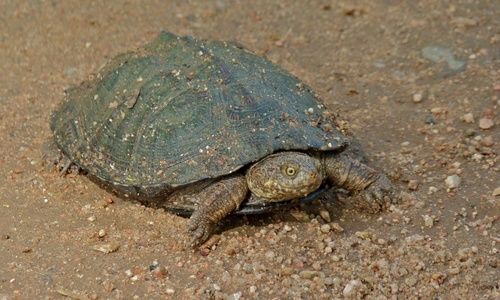
Serrated Hinged Terrapin
Pelusios sinuatus
The Serrated Hinged Terrapin is Africa’s largest hinged turtle, known for its jagged shell and remarkable ability to 'box' itself in for protection. A frequent sight on sun-drenched river logs, this resilient reptile is a master of the freshwater ecosystem.
Quick Identification
Size
Shell length typically 30-40 cm (12-16 inches), with large specimens reaching 55 cm (22 inches); weight ranges from 3-7 kg (6.6-15.4 lbs).
Colors
Dark brown to black carapace; yellow plastron with a distinct black angular pattern around the edges; skin is grey-brown with yellow accents on the head.
Key Features
- Distinctly serrated or 'toothed' rear margin of the upper shell
- Hinged front section of the plastron that allows the turtle to protect its head
- Large, robust body compared to other African terrapins
- Two small sensory barbels located under the chin
When You’ll See Them
Sightings on EverydayEarth
Jul 29, 2026
A calm morning at the watering hole. A Grey Heron stands perfectly still on the left bank, waiting for prey. On the far side, a pair of Egyptian Geese forage along the muddy bank. In the center of the pool, a Serrated Hinged Terrapin swims slowly, its head periodically breaking the surface of the water.
Jul 28, 2026
A Serrated Hinged Terrapin is perched on the muddy bank of a waterhole, basking in the sunlight. It remains mostly stationary, occasionally shifting its head slightly while observing the water's edge.
Jul 24, 2026
A hippopotamus rests largely submerged in the water, with only its back and the top of its head exposed. Four terrapins are seen basking on the hippo's back, occasionally adjusting their positions and stretching their necks as the hippo remains still in the gentle current.
Jul 24, 2026
A Common Hippopotamus rests quietly in a body of water with its broad back breaking the surface. Four Serrated Hinged Terrapins are perched on the hippo's back, taking advantage of the stationary platform to bask in the early morning light.
Jul 24, 2026
A large Common Hippopotamus rests quietly in the water, with only its back and the top of its head exposed. Four Serrated Hinged Terrapins have climbed onto the hippo's back to bask in the morning sunlight, taking advantage of the stable platform above the water.
Jul 22, 2026
A hippopotamus rests almost entirely submerged in a watering hole, with only its ears, eyes, and nostrils visible above the water line. Six terrapins are perched on the hippo's broad, exposed back, using it as a floating platform for basking in the morning sunlight.
Geographic range
Where Does the Serrated Hinged Terrapin Live?
Native to the African continent, the Serrated Hinged Terrapin thrives across East and Southern Africa. Its core range spans from the southern tip of Somalia and Ethiopia, extending through Kenya, Tanzania, and Malawi into the massive river systems of Zambia and Mozambique. It is particularly common in the lowveld regions of Zimbabwe, Botswana, and northern South Africa, where it dominates permanent freshwater habitats.
Basemap © OpenStreetMap contributors
Behavior
The Serrated Hinged Terrapin is a highly aquatic reptile that spends a significant portion of its day basking on half-submerged logs, rocks, or even the backs of hippos. These sunbathing sessions are essential for thermoregulation and help rid the shell of parasites. While they appear lethargic while basking, they are incredibly wary; at the slightest sign of danger or the vibration of an approaching human, they will slide rapidly into the safety of the water.
Unlike many other turtles, this species is known for its somewhat aggressive temperament when handled, often emitting a foul-smelling musk from glands near the legs to deter predators. Their most famous behavioral trait is the use of the 'hinge' on the lower shell (the plastron). When threatened, the terrapin can pull its head and front limbs inward and pull the front part of the lower shell upward, partially sealing itself inside like a fortress.
EverydayEarth exclusive
Camera Tips
To capture high-quality footage of the Serrated Hinged Terrapin, your best bet is to target their basking sites. Look for logs or flat rocks that protrude from the water in areas with low human traffic. Secure your camera to a nearby tree or a weighted stake on the bank, angling it slightly downward toward the basking spot. Because these reptiles have excellent eyesight, ensure your camera is well-camouflaged and use a fast trigger speed to catch them before they dive.
If you are setting up a camera in a backyard near a dam or river, try placing it about 12-18 inches off the ground. Terrapins often follow the same well-worn paths when moving between water bodies or looking for nesting sites. A camera positioned along these 'turtle highways' can provide fantastic close-up shots of their unique shell serrations and facial markings.
Time of day is crucial; these terrapins are cold-blooded and most active during the heat of the day. Set your camera to take bursts of photos or short video clips between 10 AM and 3 PM when the sun is at its peak. While baiting isn't usually necessary for basking shots, placing a small amount of smelly fish or canned cat food near the shoreline can sometimes lure them into frame for a closer look at their foraging behavior.
Frequently Asked Questions
Record Serrated Hinged Terrapin at your habitat
Connect a camera to start building your own species record — AI identifies every visitor automatically.