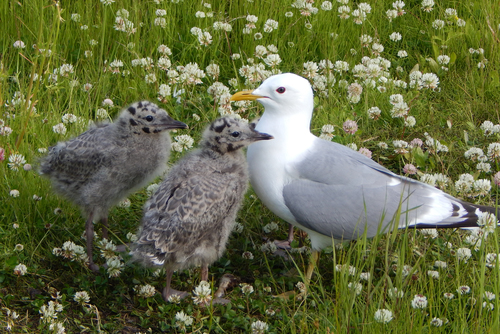
Short-billed Gull
Larus brachyrhynchus
A refined and elegant visitor from the North, the Short-billed Gull is easily identified by its gentle expression and small, unmarked yellow bill. Often seen in playful flocks along the Pacific coast, this agile gull is a delight for backyard observers.
Quick Identification
Size
Length: 15–17 in (38–43 cm); Wingspan: 41–47 in (105–120 cm); Weight: 11.5–20.5 oz (325–580 g)
Colors
Adults have a pearl-gray mantle and white underparts. They feature a small, unmarked greenish-yellow bill, dark eyes, and greenish-yellow legs. Winter adults have dusky streaking on the head.
Key Features
- Small, unmarked greenish-yellow bill without spots or rings
- Large, dark eyes that provide a 'gentle' facial expression
- Greenish-yellow legs and feet
- Rounded head and relatively small body compared to other gulls
When You’ll See Them
Behavior
Short-billed Gulls are noticeably more social and less aggressive than the larger 'four-year' gulls like the Glaucous-winged Gull. They are agile fliers and often gather in large, tight-knit flocks, particularly during the winter months when they descend upon coastal mudflats, estuaries, and even flooded suburban parks. You will often see them performing a 'foot-pattering' dance on wet grass or sand to bring invertebrates to the surface.
Unlike their more urban-adapted cousins, Short-billed Gulls tend to be slightly more wary of direct human contact, though they are frequent visitors to backyard feeders near the coast. They exhibit a complex range of vocalizations, including high-pitched, squealing 'kew' notes that lack the harshness of the larger gull species. During the breeding season, they are unique among North American gulls for their tendency to occasionally nest in trees near northern lakes.
EverydayEarth exclusive
Camera Tips
To capture the best footage of a Short-billed Gull, place your camera at a very low angle, ideally no more than 6 to 12 inches off the ground. Since these gulls spend a significant amount of time walking and foraging on the ground—especially on lawns or near the shoreline—a low perspective provides an intimate, 'eye-level' view that captures the detail of their small bill and expressive dark eyes. If you have a flat, open space in your yard, stake your camera near a low-profile birdbath or a shallow water feature, as they are frequently drawn to freshwater for drinking and bathing.
When it comes to camera settings, speed is your friend. Short-billed Gulls are highly active and can be skittish; set your PIR sensor to 'High' sensitivity and reduce the trigger delay to the shortest possible interval (ideally under 0.5 seconds). Because their white plumage can easily 'blow out' and lose detail in bright sunlight, try to position the camera so the sun is at its back, or use an exposure compensation setting of -0.3 or -0.7 if your camera allows it. This ensures the subtle gray-to-white gradients on their wings are preserved.
In terms of lures, you don't necessarily need birdseed. These gulls are highly attracted to shallow, splashing water or even 'shiny' objects. A slow-dripping water source can be an irresistible draw. If you are in a suburban setting, they are most likely to visit after a heavy rain when worms come to the surface. Timing your camera deployment to coincide with winter rainstorms in the Pacific Northwest will dramatically increase your capture rate. During these times, they are less picky and will often spend hours foraging in front of a well-placed lens.
Similar Species
Species that look similar or are commonly confused with Short-billed Gull.
Ring-billed Gull
Larger with a prominent black ring on the bill and bright yellow eyes instead of dark ones.
Common Gull
The Eurasian counterpart; nearly identical but rarely seen in North America, with slightly different wing patterns.
California Gull
Much larger with a red and black spot on the lower mandible and darker gray wings.
Frequently Asked Questions
Record Short-billed Gull at your habitat
Connect a camera to start building your own species record — AI identifies every visitor automatically.